
Sharing Hawaiʻi’s Music in Wisconsin
While the soldiers of the 100th Infantry Battalion trained for war at Camp McCoy, Wisconsin, they also brought something else with them from Hawai‘i: its music, dance, and spirit of aloha.
A group of soldiers from Hawai‘i called “The Hawaiian Serenaders” entertained fellow servicemen and communities throughout Wisconsin during the summer of 1942. The ensemble was organized by Private First Class Fred Matsuo, who brought the musicians together. Private First Class James Kaleikapu Kaholokula, known to his fellow soldiers as “Kalei,” was a talented guitarist and singer who served as the musical director.
The group included hula dancers Charlie Diamond, Private Robert Kapuniai, and Private Edward Enomoto; Sergeant Bill Kato and Corporal Harry Yoshizaki, who provided vocal harmonies; and James Kaholokula’s relatives, Edward Kaholokula and Daniel Kaleialoha. James played guitar and performed solos, including the distinctive falsetto singing for which he became known.
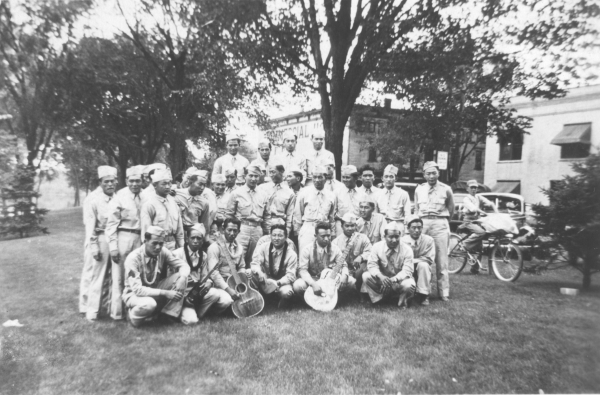
The Serenaders quickly became a popular addition to the 100th Infantry Battalion’s activities beyond the training grounds of Camp McCoy. By July 1942, the group had performed at the Sparta Courtyard, the baseball park in La Crosse, International House at the University of Chicago, radio stations in La Crosse and Wisconsin Rapids, Witter Ball Park in Wisconsin Rapids, and the Sparta New Site Ball Park, where they performed for an Army and Navy relief benefit.
Their repertoire introduced mainland audiences to familiar sounds from Hawai‘i. Programs included songs such as “Song of the Islands” and “Hawaiian War Chant,” and performances usually concluded with “Aloha ʻOe.” The combination of Hawaiian music, guitar and ukulele, singing, and hula quickly made the group a popular attraction.
The Serenaders also traveled with the 100th Infantry Battalion baseball team, the Aloha Team, as the soldiers visited communities throughout Wisconsin. A July 1942, account in the Camp McCoy installation newspaper, The Real McCoy, described the baseball team as traveling extensively throughout the state and “creating plenty of goodwill.” Under the direction of Major James Lovell and Lieutenant Katsumi Kometani, the team had visited Oakdale, Viroqua, Mindoro, Wisconsin Rapids, Onalaska, Madison, and Cashton. On several of these trips, The Hawaiian Serenaders accompanied the players.
One of their most memorable appearances came during the battalion’s visit to Madison, Wisconsin, in late July 1942. Nearly 400 soldiers arrived in the state capital on seven chartered buses and four Army trucks, accompanied by a police escort. The soldiers were greeted enthusiastically by residents and were official guests of the American Legion.
After a parade around the Capitol Square, the soldiers attended a dance at the American Legion clubhouse, where the USO and Madison Service Council provided dancing partners. When The Hawaiian Serenaders took the stage, the atmosphere changed.
The Real McCoy described the group opening its program with the “mellow tune” of the ukulele and guitar as the hula dancers took the floor. The performance made the audience “Hawai‘i conscious,” according to the newspaper, with the dancers performing hula and Corporal James “Kalei” Kaholokula entertaining the crowd with his solos in his characteristic falsetto.
The performance also provided an opportunity for the soldiers to exchange gifts of friendship with their hosts. PFC Fred Matsuo presented Judge M. Evans, chairman of the Madison American Legion, with a lei on behalf of the 100th Infantry Battalion. Judge Evans responded with a gift of Wisconsin “Longhorn” cheese, presented on behalf of Governor Julius Heil and Ralph Ammon, director of the Wisconsin Department of Markets.
Dr. Isamu Tashiro of Chicago, a Nisei dentist and longtime member of the Hawai‘i community there, was also presented with a lei. An old friend from Hawai‘i, Tashiro brought several young women from the University of Chicago’s International House to the Madison event, much to the delight of the soldiers, who had the opportunity to dance with them.
The Serenaders’ music was not limited to dances and community celebrations. During the Madison visit, the group was asked to perform at the University of Wisconsin Orthopedic Hospital. While many invitations had been extended to the soldiers, the Serenaders entertained more than 100 children at the hospital.
Their performance left a lasting impression. According to The Real McCoy, the children surrounded the soldiers afterward with autograph books. As they prepared to leave, the soldiers told the children, “We had more fun playing for you than for any other audience.”
They encouraged the children to “keep on fighting” and expressed the hope that they would see them in Hawai‘i someday.
The visit demonstrated another dimension of the Serenaders’ role. Their music was not simply entertainment for fellow soldiers or a colorful addition to public events. It became a way for the men of the 100th to connect with people they encountered far from Hawai‘i and to introduce communities to the culture from which they had come.
The Serenaders’ performances also carried a distinctly Hawaiian gesture of hospitality. At the conclusion of their performances, the soldiers gave their lei to members of the audience. For many recipients, receiving a lei from a soldier from Hawai‘i was a memorable experience and a tangible expression of the friendship the soldiers sought to build.
The Madison visit continued beyond the weekend. On Monday evening, as the soldiers prepared to leave the city, The Hawaiian Serenaders once again performed, singing and dancing hula for the people who had gathered to see them off.
For the men of the 100th Infantry Battalion, these performances offered moments of music, fellowship, and connection during a period of intense military training, when the loyalty of Americans of Japanese ancestry was being questioned.
In September 1987, Mitsuyoshi “Mits” Fukuda, former commander of Company A and the last commanding officer of the 100th Infantry Battalion, returned to Camp McCoy with a group of Company A veterans and their wives. Reflecting on the battalion’s experience in Wisconsin, he recalled that the men had been “shipped out under a cloud, questioning their patriotism.” He added, “The greatest part of the war was that the people of Wisconsin treated us like human beings. It restored our confidence.”
For the communities that welcomed them, The Hawaiian Serenaders offered an introduction to Hawai‘i through the songs, dances, instruments, and traditions carried by young men thousands of miles from home. The performers demonstrated that the soldiers of the 100th carried more than their military training with them. They carried the music and culture of Hawai‘i — and wherever they performed, they shared a little of home.