
The Attack on Pearl Harbor and Immediate Response
At 7:55 a.m. on December 7, 1941, the usual calm of a Sunday morning in Honolulu was shattered by the sound of explosions. Aircraft bearing the bright red insignia of Imperial Japan launched a devastating surprise attack on the naval base at Pearl Harbor and military airfields across Oʻahu.
Military personnel rushed to their stations, but there was little they could do to counter the ferocity of the assault. Within hours, the attack had destroyed aircraft and battleships, claimed the lives of military personnel and civilians, and thrust the United States into World War II.
![Pearl Harbor Disaster [Honolulu Star-Bulletin]](https://www.100thbattalion.org/wp-content/gallery/battalion-history-war-is-declared/just-americans_01.jpg "Pearl Harbor Disaster [Honolulu Star-Bulletin]")
Within hours of the attack, martial law was declared, placing the Territory of Hawaiʻi under military control. Agents of the Federal Bureau of Investigation, military personnel, and police arrested individuals they considered potential security risks, including Japanese religious leaders, language school teachers and principals, martial arts instructors, community leaders, reporters and editors of Japanese-language newspapers, and Kibei (American-born Japanese who had spent part of their upbringing or education in Japan). Within two days of the attack on Pearl Harbor, nearly 500 individuals had been arrested and confined at Sand Island, which served as an initial detention center. German and Italian nationals were also arrested, though in far smaller numbers than Japanese residents.
On December 8, 1941, one day after the attack on Pearl Harbor, the United States declared war on Japan. Three days later, following Germany and Italy’s declarations of war against the United States, Congress declared war on both countries.
In the days and weeks following the attack, Hawaiʻi’s Japanese community lived in constant uncertainty and fear over what might happen next. Across the islands, families watched husbands, fathers, and community leaders taken away by authorities, often with little or no information about where they were being held or whether they would ever return home.
Japanese households throughout Hawaiʻi, particularly families connected to Buddhist temples, language schools, newspapers, martial arts groups, or community organizations, were often subjected to searches and intimidation. During these raids, family heirlooms, photographs, and possessions perceived as connected to Japan were frequently confiscated and, in some cases, destroyed.
Hawaii National Guard in the First Months of the War
During the December 7 attack on Pearl Harbor, the 1st Battalion of the 298th Infantry Regiment was stationed at Schofield Barracks, while the 2nd Battalion was deployed in defensive positions along Oʻahu’s windward coast, in areas extending between Bellows Field and Kualoa. Many of the AJA soldiers assigned to the 1st Battalion were away on weekend pass at the time of the attack but promptly returned to Schofield and reported for duty in the immediate aftermath.
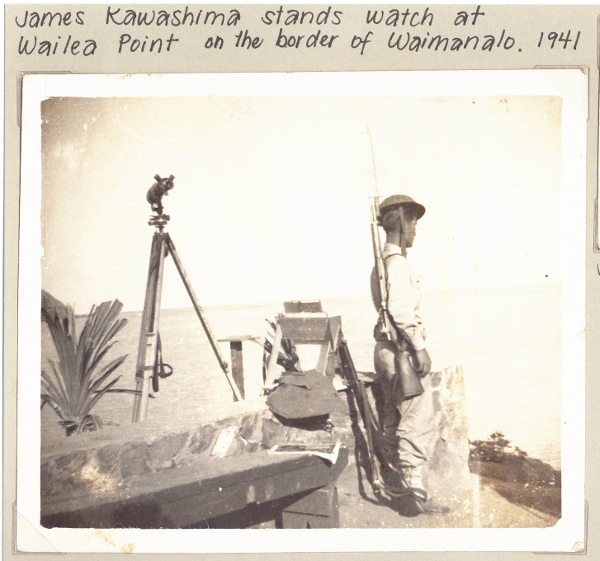
For the next six months, through May 1942, American soldiers of Japanese ancestry in the 298th and 299th Infantry Regiments continued to serve in their assigned roles, with no sustained change in their participation in defensive duties. In the first days following the December 7 attack, some units imposed brief and uneven restrictions on access to weapons for AJA soldiers amid confusion and heightened alert conditions, but these measures lasted only a few days and were not uniformly applied. In practice, these Hawaii National Guard units remained actively engaged in frontline defensive duties, including coastal patrols, fortification work, and the operation of security positions throughout Oʻahu and the neighbor islands.
Military Intelligence and the Morale Section
On December 17, 1941, Lieutenant General Delos C. Emmons became military governor of Hawaiʻi and commanding general of the U.S. Army’s Hawaiian Department, replacing Lieutenant General Walter C. Short. In the weeks following the attack on Pearl Harbor, Emmons faced intense pressure to address concerns over Hawaiʻi’s large Japanese population. He initially believed that the population might pose a security risk, and in early discussions the possibility of mass evacuation was raised.
![Barbed wire covers a Hawaiian beach after the bombing of Pearl Harbor, 1942 [Courtesy of Ruth Oian Pratt, Bishop Museum]](https://www.100thbattalion.org/wp-content/gallery/battalion-history-war-is-declared/chang_thelma_011.jpg "Barbed wire covers a Hawaiian beach after the bombing of Pearl Harbor, 1942 [Courtesy of Ruth Oian Pratt, Bishop Museum]")
A key figure in the military government’s internal security structure was Lieutenant Colonel Kendall Fielder, who succeeded Lt. Col. M. W. Marston in July 1941 as Assistant Chief of Staff, G-2 (Military Intelligence) of the Hawaiian Department. Prior to this assignment, Fielder had helped train AJA soldiers in the 298th Infantry Regiment.
In December 1941, the Morale Section of the Military Governor’s Office was established to help manage civilian morale and race relations under martial law. It drew upon an existing network of prewar civic cooperation formed through the Council for Interracial Unity. Its members included Hung Wai Ching, Shigeo Yoshida, and Charles Loomis, all of whom emphasized the loyalty of Hawaiʻi’s Japanese American community and advocated for fair treatment.
An Emergency Service Committee was appointed by the Morale Section in February 1942 to work among the people of Japanese ancestry in Hawaiʻi. During a period of widespread suspicion and uncertainty, the committee played an important role in maintaining communication between military authorities and the local Japanese American community. It worked to ease racial tensions and dispel rumors, advocated for the rights and loyalty of AJA residents and soldiers, and supported the participation of Japanese Americans in the war effort, including the 100th Infantry Battalion, the 442nd Regimental Combat Team, and the Military Intelligence Service.
Working in coordination with Col. Fielder and FBI Special Agent Robert Shivers, the Morale Section and Emergency Service Committee assessed community sentiment and helped maintain stability during the early months of the war. Fielder worked closely with Shivers on intelligence and internal security matters and also coordinated with civilian advisers connected to the Morale Section and ESC.
The Hawaii Territorial Guard and the Formation of the Varsity Victory Volunteers
Shortly after the attack on Pearl Harbor, Governor Joseph Poindexter created the Hawaii Territorial Guard (HTG) to serve as a territorial defense force under his authority, as the Hawaii National Guard had already been federalized and placed under U.S. Army command. University of Hawaiʻi Reserve Officers’ Training Corps (ROTC) cadets were among those incorporated into the HTG and assigned to guard key installations across Oʻahu. Members were issued old Springfield rifles and, according to some accounts, a single clip of five rounds, and were deployed to protect generators, power stations, and other critical infrastructure.
However, in January 1942, amid pressure from Washington, Emmons ordered that approximately 317 AJA members of the HTG be relieved of their duties. On January 21, 1942, the Hawaii Territorial Guard was formally dissolved and immediately reconstituted without its AJA members. Surprised, angry, and disappointed, the men nonetheless remained determined to find another way to serve their country.
With encouragement from Hung Wai Ching of the Morale Section, 169 former HTG members signed a petition to Emmons about a month later, offering themselves “for whatever service you may see fit to use us.” Ching submitted the petition through Lt. Col. Fielder, who helped convince Emmons to approve their proposal to organize a volunteer labor battalion. Formed in February 1942, the unit became known as the Varsity Victory Volunteers.
Mass Incarceration and Internment
On January 5, 1942, the War Department reclassified Japanese American men of draft age as “IV-C enemy aliens,” rendering them ineligible for enlistment in the U.S. armed forces. Despite this change in classification, Japanese American soldiers already serving in the 298th and 299th Infantry Regiments continued to carry out their assigned duties in the defense of Hawaiʻi.
On February 19, 1942, President Franklin D. Roosevelt signed Executive Order 9066, authorizing the forced removal and incarceration of more than 110,000 people of Japanese ancestry from the West Coast, most of whom were American citizens. Many were sent to camps in remote inland areas, including Arkansas.
In Hawaiʻi, where nearly 160,000 residents were of Japanese ancestry, mass incarceration was not experienced on the scale of the West Coast. According to statistics compiled by the Japanese Cultural Center of Hawaiʻi, approximately 1,330 Japanese Americans and Japanese nationals from Hawaiʻi were interned during World War II, either in camps within the islands or on the continental United States. In addition, about 940 family members voluntarily relocated to mainland camps to remain with incarcerated relatives.
There was considerable debate among military and political leaders over whether Hawaiʻi’s large Japanese population posed a security risk and should be subject to mass internment. In the end, however, officials concluded that incarcerating such a large portion of the islands’ population was both logistically and economically impractical, as many Japanese residents occupied essential roles in Hawaiʻi’s workforce and held vital skilled labor positions. Furthermore, despite rumors of sabotage and espionage following the attack on Pearl Harbor, military authorities found no evidence that such activities in Hawaiʻi had been carried out by residents of Japanese ancestry.
While some early proposals explored restrictive or drastic measures, Emmons relied heavily on the advice of the combined network of intelligence and the Morale Section. Over time, he concluded that mass removal or broad restrictive measures were neither necessary nor practical given conditions in the islands.
Formation of the Hawaiian Provisional Infantry Battalion
![Lieutenant General Delos Emmons [U.S. Signal Corps]](https://www.100thbattalion.org/wp-content/gallery/battalion-history-war-is-declared/just-americans_02.jpg "Lieutenant General Delos Emmons [U.S. Signal Corps]")
In February 1942, when the War Department suggested that AJA soldiers be released from duty or transferred, Lt. Gen. Delos Emmons opposed the proposal, arguing that they were essential because of insufficient troop levels in Hawaiʻi. As a result, Japanese American soldiers in U.S. Army units such as the 298th and 299th Infantry Regiments remained in service and continued their defensive duties during this period of uncertainty.
In March 1942, Assistant Secretary of War John J. McCloy visited Hawaiʻi after supporting General John L. DeWitt’s implementation of Executive Order 9066. Signed in February 1942, the order authorized the mass removal and incarceration of Japanese Americans on the West Coast. While in Hawaiʻi, McCloy met with Emmons and inspected military units, including the 298th and 299th Infantry Regiments and the Varsity Victory Volunteers. He was reportedly impressed by the performance and discipline of the AJA soldiers he observed, and the visit contributed to a shift in his perspective.
Emmons, McCloy, Lt. Col. Kendall Fielder, and local civilian leaders discussed organizing Hawaiʻi’s AJA infantrymen into a separate combat unit for overseas service as a demonstration of loyalty and effectiveness. However, the War Department rejected the proposal amid continuing doubts about the reliability of Japanese American soldiers.
By late spring 1942, additional mainland reinforcements had arrived in Hawaiʻi, and in May the 298th Infantry Regiment was moved into reserve while newly arrived troops assumed many frontline defensive positions. At the same time, intelligence reports indicated that the Japanese navy was preparing a major offensive against Midway Atoll, a strategic outpost northwest of the Hawaiian Islands. Military leaders feared that if Midway fell to Japan, Hawaiʻi might be Japan’s next target.
Against this backdrop, General Emmons recommended to the War Department that a special battalion of AJA soldiers from the 298th and 299th Infantry Regiments be organized and transferred to the mainland. With fears of a possible Japanese attack on Hawaiʻi, concerns persisted within military leadership about the reliability of some AJA soldiers, and there were also worries that they might be mistaken for enemy troops in the event of an invasion.
In late May 1942, General George Marshall, the Army’s Chief of Staff, approved the formation of a provisional infantry battalion composed primarily of AJA soldiers from the 298th and 299th Infantry Regiments. Several AJA soldiers stationed at Schofield Barracks who had been assigned to the 3rd and 65th Engineer Combat Battalions of the 24th Infantry Division were also included in the new unit. Designated the Hawaiian Provisional Infantry Battalion, it was ordered to depart Hawaiʻi on the first available transport.
Formation of the 100th Infantry Battalion (Separate)
Lieutenant Colonel Farrant L. Turner, executive officer of the 298th Infantry, immediately volunteered to command the battalion. Born and raised in Hawaiʻi, he had served as an officer in the National Guard since 1926 and was impressed with the outstanding performance of the AJA in the unit. Additionally, in his civilian position with a large supply company, Turner had worked with Issei contractors and gained insight into the values that guided their lives and that of their Nisei children.
For his second-in-command, the position of executive officer, Turner chose Captain James W. Lovell, who had served as his training officer in the Hawaiʻi National Guard. Born in Nebraska, Lovell had lived in Honolulu since 1930 and had taught and coached many Nisei and Sansei students at local schools. Many of his former students were now soldiers in the 298th and were pleased that he would be one of their officers. Turner and Lovell would become highly respected by the men of the 100th for the key roles they played in the battalion’s history.
Because Turner had been informed that no officer of Japanese ancestry could command a rifle company, he selected several haole (Hawaiian word for Caucasian) officers who had either been born in Hawaiʻi or had spent many years in the islands and were familiar with the local Japanese American community. These included Alex E. McKenzie, Philip B. Peck, John A. “Jack” Johnson, Clarence R. Johnson, and Charles A. Brenaman, all of whom had strong Hawaiʻi connections and were considered well suited to work with the AJA enlisted men.
Four Nisei officers were selected for Headquarters Company. Captain Taro Suzuki and Captain John M. Tanimura were Army Reserve officers who had been called to active duty in 1940 and were appointed supply officer and utilities officer, respectively. Captain Isaac A. Kawasaki, a physician in the Army Medical Corps who had entered active duty in 1941, served as the battalion surgeon. 1st Lieutenant Katsumi Kometani, a dentist and the only Nisei not discharged from the Hawaii Territorial Guard after the January 1942 dismissals, was appointed morale officer.
When Turner completed his appointments, 16 of the battalion’s officers were of Japanese ancestry. Most of the AJA officers were graduates of the University of Hawaiʻi who had earned their commissions by completing the ROTC program.
On May 28, 1942, the 1,432 men of the newly formed provisional infantry battalion assembled at Schofield Barracks. Although the overwhelming majority of the enlisted men were of Japanese ancestry, a small number of soldiers from other ethnic backgrounds also joined the unit. The soldiers were required to turn in their weapons, and no passes were issued. They were informed that they would be sent to somewhere on the mainland for training and were ordered to keep the information a secret from their families. Despite the secrecy, some learned of the departure and gathered at Honolulu Harbor to bid farewell to their sons and brothers.
On June 5, 1942, the Hawaiian Provisional Infantry Battalion was formally organized at Schofield Barracks. The men boarded the transport ship USAT Maui and departed Hawaiʻi as part of a convoy of four transports under naval escort. No public announcement of the departure appeared in newspapers or radio broadcasts.
With fears of a possible Japanese invasion of Hawaiʻi and concerns for their families still lingering, many of the AJA soldiers initially felt uneasy about leaving the islands. Their spirits were later lifted by radio reports received at sea of the American victory at the Battle of Midway, which greatly reduced the threat of a Japanese invasion of Hawaiʻi.
Upon arriving in Oakland, California, the unit was officially activated on June 12, 1942, as the 100th Infantry Battalion (Separate), the first segregated combat unit in the U.S. Army composed primarily of Americans of Japanese ancestry.