
The First Five Months – From Salerno to Cassino
(Naples-Foggia Campaign / Rome-Arno Campaign)
Arrival in Italy and the Salerno Beachhead
The 100th Infantry Battalion (Separate), now attached to the 34th Infantry Division’s 133rd Infantry Regiment, landed on the beachhead at Salerno in southern Italy on September 22, 1943. The battalion was the first AJA (Americans of Japanese ancestry) unit of World War II to engage in combat in the European-African-Middle Eastern Theater.
![October 12, 1943, Italy. Japanese-American soldiers of the U.S. 100th Infantry Battalion taking position behind an embankment during mock maneuvers. [Photograph by U.S. Army Signal Corps]](https://www.100thbattalion.org/wp-content/gallery/photos-italy/Italy1.png "October 12, 1943, Italy. Japanese-American soldiers of the U.S. 100th Infantry Battalion taking position behind an embankment during mock maneuvers. [Photograph by U.S. Army Signal Corps]")
Although the Fifth Army had already secured the beachhead, German aircraft continued to launch intermittent attacks, particularly targeting the airfield and ships in the harbor. By this time, German forces had withdrawn northeast toward higher ground.
After climbing down into landing craft, the soldiers made their way toward the beach. Most of the craft reached the shore, but one carrying Major James Lovell became stuck on a reef. When the ramp was lowered, Lovell led his men into the water, which was deep enough to submerge some of them completely. They pushed through the water toward shore, carrying their rifles and full packs, and made their way onto the beachhead. For the men of the 100th, this was their first landing in a combat theater and the beginning of their ground campaign in Italy.
Alongside the other two battalions of the 133rd Infantry Regiment, the 100th Infantry Battalion crossed the Salerno Plain toward Montecorvino. As the regiment moved into action, officers of Fifth Army units were sent this message: “There has recently arrived in this theater a battalion of American soldiers of Japanese ancestry. These troops take particular pride in their American origin. Your command should be so informed in order that during the stress and confusion of combat, cases of mistaken identity may be avoided.”
On the night of September 26, 1943, the 100th entered combat operations, pursuing retreating German forces through rain and muddy terrain.
Two days later, on September 28, a squad from Company B captured the battalion’s first German prisoner, who had been hiding in a nearby farmhouse. Able to speak a little English, the prisoner initially wondered whether the soldiers were Chinese. When told they were Japanese, he was reportedly led away believing that Japan had joined the Allies against Germany.
That same day, Sergeant Conrad Tsukayama (Co. D) became the 100th’s first casualty when he was injured by an anti-tank mine. Sent to a hospital for treatment, he became the first member of the 100th to receive the Purple Heart and the first of many AJA soldiers who would discharge themselves from the hospital without permission and return to their unit.
Early Combat Operations and Recognition
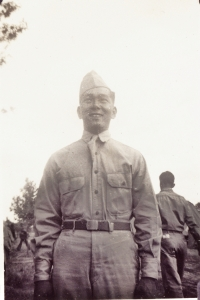
On September 29, 1943, the 100th Infantry Battalion engaged in combat with German forces for the first time. Sergeant Joseph Shigeo “Joe” Takata of Company B became the first member of the battalion — and the first soldier from an AJA unit — to be killed in action during the war. One of the original members of the 100th Infantry Battalion, Takata volunteered to lead the advance toward concealed German machine-gun positions, reportedly saying, “It’s the first time, so I’m going first.” Though mortally wounded while advancing under heavy enemy fire, he succeeded in revealing the position of the enemy gunners to his comrades before dying. According to fellow soldiers, his final words were, “Carry On! Carry On! Carry On!” For his heroism, Takata was posthumously awarded the Distinguished Service Cross and the Purple Heart.
Less than an hour later, Private Keichi Tanaka (Co. B) was killed by another burst of machine-gun fire and was also posthumously awarded the Purple Heart. By the end of its first day of active combat, the battalion had suffered at least 15 additional battle casualties.
In early October 1943, the 100th participated in the capture of Benevento, a strategically important railroad and road junction northeast of Naples.
The 100th’s performance during its advance from Montemarano to Montefalcione and its actions at Benevento earned recognition from Lieutenant General Mark W. Clark, commander of the U.S. Fifth Army. In a message to General Dwight D. Eisenhower, Clark praised the battalion for its excellent efficiency and “prompt reaction to enemy opposition,” noting that other troops had accepted the battalion with “confidence and friendliness due to good behavior and high courage.”
Clark later recalled, “I sent a cable to Eisenhower on October 8, stating that they had seized their objective and were quick to react whenever the enemy offered opposition.” He also noted that sickness and hospitalization were “almost nil” because of the soldiers’ strong desire to remain with their unit.
Describing the battalion’s first combat operations, Clark wrote that during the advance to the Volturno, the 100th served as the advance guard for a regimental combat team and advanced “approximately 15 miles in 24 hours, operating day and night in the face of strong enemy resistance and over difficult terrain.”
Clark’s report on the 100th’s performance during its first battle test was published in the 34th Infantry Division news bulletin and greatly boosted morale within the battalion. It also drew attention from Army leadership. A letter from the Army Ground Forces headquarters in Washington, D.C. quoted a War Department memorandum praising the battalion’s conduct and asked that its contents be shared with military personnel at units and installations where AJA soldiers served. The letter stated that, despite suffering casualties, the 100th continued their advance on schedule and used all of its weapons with complete assurance. It was also noted that an AJA sergeant who had been killed in the action had been recommended for the Distinguished Service Cross.
Clark would later write in his memoir, “Calculated Risk”:
“I should mention here that a bright spot in this period was the performance of the 100th Battalion, which had recently been assigned to the 34th Division. This battalion was made up of Japanese-Americans and was to become one of the most valuable units in the Fifth Army. As the first Japanese-American unit in the United States Army, the 100th Infantry Battalion was organized in the vicinity of Pearl Harbor…These Nisei troops seemed to be very conscious of the fact that they had an opportunity to prove the loyalty of many thousands of Americans of Japanese ancestry and they willingly paid a high price to achieve that goal. I was proud to have them in the Fifth Army.”
Following the battalion’s actions in combat at Benevento, Major General Charles Ryder authorized the soldiers of the 100th to wear the 34th Infantry Division’s Red Bull shoulder patch as a symbol of his high regard for the battalion. Ryder personally distributed the patches as a sign of his respect and high regard for the men of the 100th. The men continued to wear the insignia proudly even after later being attached to the 442nd Infantry Regiment in 1944.
Fighting Across the Volturno
In mid-October 1943, the 100th Infantry Battalion was ordered west. The battalion crossed the Volturno River twice, and at one point the cold, rapidly flowing water was chest-high as the soldiers, who averaged only five feet four inches tall, crossed the Volturno with their weapons and packs.
![October 12, 1943, Italy. Pfc. Arthur Shinyama, Japanese-American B.A.R. gunner of U.S. 100th Infantry Battalion taking position during mock maneuvers. [Photograph by U.S. Army Signal Corps]](https://www.100thbattalion.org/wp-content/gallery/photos-italy/Italy2.png "October 12, 1943, Italy. Pfc. Arthur Shinyama, Japanese-American B.A.R. gunner of U.S. 100th Infantry Battalion taking position during mock maneuvers. [Photograph by U.S. Army Signal Corps]")
The fighting around Alife and Sant’Angelo d’Alife on October 20–22, 1943, proved especially fierce. Advancing at night against heavily entrenched German positions overlooking the exposed approaches, the 100th endured intense machine-gun, mortar, artillery, and Nebelwerfer rocket fire while attacking across open ground and heavily mined terrain. It was the first time the soldiers encountered German Nebelwerfer rocket launchers — nicknamed “screaming-meemies.” Although the battalion suffered heavy casualties, including the wounding of Major James Lovell, the 100th and the 3rd Battalion of the 133rd Infantry Regiment eventually secured key road junctions on the surrounding high ground near Sant’Angelo d’Alife.
The battle also brought acts of extraordinary courage. Private First Class Thomas Yamanaga (Co. A) silenced an enemy machine-gun nest with his automatic rifle so his squad could advance, but was mortally wounded. He was posthumously awarded the unit’s second Distinguished Service Cross. Private Masao Awakuni (Co. C) destroyed an enemy lead tank with his bazooka and was awarded the Bronze Star Medal for his action. Other acts of courage during the battle earned Silver Stars for several men.
On October 29, 1943, barely a month into combat, the men of the 100th received the shocking news that Lieutenant Colonel Farrant L. Turner had been relieved of command and ordered to a hospital. At 48 years old, Turner was older than most combat battalion commanders, and the strain of command and the deaths of his troops had taken a heavy emotional toll on him. With Major Lovell hospitalized while recovering from his wounds, Major James Gillespie was assigned to command the battalion. Then, following the battle for La Croce Hill about one month later, Gillespie had to be hospitalized and was replaced by then second-in-command, Major Caspar Clough.
The Battles for the Hills
The 100th Infantry Battalion then fought to capture strategically important hills forming part of the German defenses protecting the approach to Monte Cassino. Monte Cassino was a key position in the German Gustav Line, part of the larger Winter Line defensive system designed to halt the Allied advance through Italy. The German defenses were anchored by rugged, mountainous terrain, minefields, and well-positioned artillery and machine guns designed to slow the Allied advance.
Throughout November 1943, the 100th engaged in a series of fierce battles against well-entrenched German forces while advancing through mountainous terrain and extensive minefields. On the night of November 3 – 4, the battalion made its third crossing of the Volturno River before fighting around Pozzilli for control of Hills 590, 600, and 610. Advancing in darkness through heavily mined terrain, soldiers used strips of toilet paper to mark safe paths after cutting trip wires and neutralizing mines by hand. Lieutenant Kurt Schemel (Co. E) became the first commissioned officer of the battalion killed in action, while Captain John Johnson Jr. (HQ) and Captain Taro Suzuki (Co. B) were among the wounded.
Casualties continued to mount throughout the campaign, including significant non-battle casualties caused by the harsh conditions. Trench foot became widespread as soldiers endured prolonged exposure to cold and wet conditions. Many delayed seeking treatment in order to remain with their unit, even when the condition became debilitating. Battalion Chaplain Israel Yost accompanied the soldiers through some of their harshest combat operations, conducting memorial services, assisting at aid stations, and following stretcher bearers onto battlefields to help retrieve the wounded.
In late November, the 133rd Infantry Regiment advanced toward Colli and the mountains east of Monte Cassino, where the 100th fought bitterly for Hills 1017, 841, 905, and 920 in an effort to reach La Croce Hill. The hills rose through steep, rugged terrain that made movement difficult and limited the 100th’s ability to bring heavy weapons forward. German forces, meanwhile, had carefully prepared and fortified their positions, giving them a strong defensive advantage. Groups of soldiers would fight their way up the slopes, only to be driven back by devastating machine-gun, mortar, and artillery fire.
On November 29, Companies A and B moved to occupy Hill 841. In the fierce fighting, Private Shizuya Hayashi (Co. A), Private Mikio Hasemoto (Co. B), Staff Sergeant Allan Ohata (Co. B), and Corporal Masaru Suehiro (Co. A) distinguished themselves through extraordinary courage under intense enemy fire. Hayashi charged enemy positions under heavy fire and destroyed a German machine-gun nest. Hasemoto repeatedly returned through enemy fire to obtain new weapons and continued fighting until he was killed in action. Ohata exposed himself to heavy machine-gun fire to aid a fellow soldier and helped his small group repel successive German attacks, killing and capturing numerous enemy soldiers. Suehiro remained at an exposed mortar observation position despite being wounded, directing accurate fire that destroyed an enemy machine-gun position and disrupted a German counterattack. All four were awarded the Distinguished Service Cross for their actions; Hasemoto’s award was posthumous. In 2000, Hayashi, Hasemoto, and Ohata had their Distinguished Service Crosses upgraded to the Medal of Honor.
At Hill 920, German defenders were forced back to the wooded summit, where they established a position the Americans could not break. Steep, unmarked trails made resupply hazardous, while freezing nights, hunger, thirst, and repeated mortar fire added to the strain. The 100th was still wearing summer uniforms, even as other units had received winter clothing. The men were unable to evacuate their wounded and had little opportunity for sleep or rest. With battalion supply unable to reach them, they went for days with almost no food or water, yet continued to hold their position under the constant threat of German counterattack.
1st Sergeant Masayoshi Kawamoto (Co. C) later recalled that when he reached the men on Hill 920, he offered water from his full canteen to those who were desperately thirsty. Although any one of them could have emptied the canteen in a single gulp, they took only a small mouthful and returned it, while others politely refused, telling him to keep the water because he would need it himself. Kawamoto noted: “I thanked God that I was fighting with such men as these. After four days and nights of hell, they were still calm and able to think of others besides themselves, keeping the spirit of unity at a time when it was most needed.”
On December 12, 1943, French troops relieved the 34th Division, allowing the battered battalion to withdraw for a brief rest. Reports indicate that Company C started out with 175 men on Thanksgiving Day, but only about 50 walked away from Hill 920. Having been depleted by heavy casualties and repeated transfers of men to reinforce other companies, Company E was officially inactivated on December 1 and Company F on December 12, with their few remaining men transferred to Company C.
By then, the 100th Infantry Battalion’s effective strength had fallen to roughly 800 men — down from more than 1,300 when it arrived in Italy just over two months earlier. For actions during this period, six members of the 100th Infantry Battalion (Separate) were awarded the Distinguished Service Cross, the U.S. Army’s second-highest award for valor in combat.
Majo Hills and Monte Cassino
In January 1944, the 100th Infantry Battalion and the 3rd Battalion of the 133rd Infantry Regiment joined the fighting in the Majo hills as Allied forces advanced toward Monte Cassino. On the night of January 7, the 100th climbed the steep, rocky, snow-covered slopes of Hill 1190 in darkness so hazardous that soldiers held hands in a line to keep from losing their footing and falling. After securing the objective, the battalion advanced toward the Rapido River valley.
The Naples-Foggia Campaign ended on January 21, 1944. By the end of the campaign, the 100th had suffered a reported 584 battle casualties.
![Monte Cassino [Courtesy of Mary Hamasaki]](https://www.100thbattalion.org/wp-content/gallery/photos-italy/italy3-hamasaki_0001.png "Monte Cassino [Courtesy of Mary Hamasaki]")
The 100th continued fighting with the 34th Infantry Division as part of the Rome-Arno Campaign, taking part in the first two Allied attempts to capture Monte Cassino, a key position controlling the main highway to Rome. The fighting around Cassino became one of the most difficult and costly battles of World War II. A Benedictine abbey stood atop Monte Cassino, overlooking the town of Cassino from the summit. German forces had established machine-gun positions along the slopes and cleared trees and brush to give them unobstructed views of approaching Allied troops.
The Germans had dammed the upper Rapido River, flooding the opposite bank southward past Cassino. The resulting massive mud lakes and mud flats severely restricted movement, while extensive minefields and barbed wire further obstructed the approaches. Allied troops attempting to cross faced heavy artillery and machine-gun fire. Evacuating the wounded was also hazardous, requiring medics to establish relay stations and four-man litter teams to carry the most seriously wounded to aid stations.
In mid-January, the 100th conducted reconnaissance and combat patrols in preparation for an attack across the Rapido River near Cassino. The 36th Infantry Division was positioned along the river slightly downstream of Cassino, while the 34th Infantry Division operated up-river, to the right of Cassino. The 36th made two attempts to cross the river, but both were repulsed by heavy German resistance, resulting in devastating casualties.
![Men hunkered down on the side of Monte Cassino [Courtesy of Ed Ikuma]](https://www.100thbattalion.org/wp-content/gallery/photos-italy/italy4-ikuma_004.png "Men hunkered down on the side of Monte Cassino [Courtesy of Ed Ikuma]")
On January 24, the 100th joined the 133rd Infantry Regiment’s attack, advancing toward the Rapido River. During the assault, Sergeant Calvin Shimogaki (HQ Co.) led his Ammunition and Pioneer Platoon. When his mine detector was disabled by enemy fire, he crawled through the mud on his stomach, using his hands to locate mines and tripwires. He cleared a path five feet wide and 50 yards long, allowing the men to advance. For his actions, Shimogaki was awarded the Silver Star.
The 100th suffered devastating casualties in repeated attempts to cross the exposed mud flats. Major Caspar Clough was relieved of command after refusing to commit the battalion to what he believed was a suicidal charge across the flats. Major George Dewey temporarily replaced him but was badly wounded during the attack, and Clough subsequently resumed command.
The battalion also lost its highly regarded officer, Major John “Jack” Johnson Jr., who was killed on January 25. Johnson, who grew up in Hawaiʻi, had originally served as the battalion’s training officer and had become executive officer after Major James Lovell was wounded near Alife in October 1943.
Major Lovell returned from the hospital on January 29, and his exhausted men greeted him enthusiastically as word quickly spread through the ranks: “The Major is back.” On February 8, under Lovell’s command, the 100th made another attempt to cross the Rapido River farther upstream. The battalion crossed the river and advanced toward Cassino, fighting to secure positions on Castle Hill. The men came under intense German machine-gun and artillery fire and were pinned down on the hillside, where they held their positions for four days. During the fighting, Lovell was severely wounded by machine-gun fire and forced out of action again.
That same day, Private Masao Awakuni (Co. C), who had previously destroyed a German tank at Alife, again distinguished himself by advancing across rocky terrain to within 30 yards of a German assault gun and, under heavy enemy fire, destroying it with a direct bazooka hit. Pinned down by sniper fire for 10 hours, he was wounded by machine-gun fire while attempting to return to his unit in the darkness. For his actions, Awakuni was awarded the Distinguished Service Cross.
With assistance from other Allied forces, the 100th succeeded in pinning down German forces halfway up the slopes of Castle Hill — one of the Allies’ few significant gains against the Gustav Line during the battle for Cassino.
The fighting around Monte Cassino continued through four major Allied assaults over four months. The 100th participated in the first two assaults before being relieved in February 1944. On February 15, Allied forces launched a massive air strike that destroyed the Benedictine abbey. The Gustav Line was finally broken in May 1944 during the fourth major Allied offensive, when fresh Allied forces succeeded in forcing the Germans to withdraw from Cassino and the Liri Valley.
Reinforcing the “Original” 100th Infantry Battalion
When the 100th Infantry Battalion (Separate) landed at Salerno in September 1943, it consisted of just over 1,300 men. After five months of intense combat, its ranks had been devastated by casualties. The battalion reported only 521 soldiers fit for duty in early February 1944, and by the end of the month its effective strength had fallen to about 460. Having suffered such heavy casualties during its first months in combat, war correspondents began referring to the 100th as “The Purple Heart Battalion.”
The battle for Monte Cassino marked the end of what the men referred to as the “original” 100th Infantry Battalion, as the depleted unit began receiving replacement officers and enlisted men from the 442nd Regimental Combat Team (RCT). The 442nd, composed primarily of all-volunteer AJA soldiers, had been training at Camp Shelby, Mississippi. Three groups of replacements joined the 100th in March, April, and May 1944, rebuilding the battalion’s strength.
Resuming Selective Service for AJA
With the 100th Infantry Battalion fighting in Italy and the 442nd RCT training for combat at Camp Shelby, the need for additional AJA soldiers to replenish the segregated Japanese American combat units continued to grow. AJA soldiers were also serving throughout the Pacific and Asia with the Military Intelligence Service (MIS). In response to the growing demand for AJA military manpower, Selective Service induction of AJA resumed on January 20, 1944.
The War Department cited the 442nd’s training and the 100th’s combat record as major factors in the decision:
“The excellent showing which the (442nd) Combat Team has made in training, and the outstanding record achieved by the 100th Battalion (a former Hawaiian National Guard unit) now fighting in Italy were major factors in the adoption of the present plan.”
Together, the 100th’s training and combat record and the 442nd’s performance in training helped counter wartime suspicions of Japanese Americans, demonstrating the military capability and loyalty of AJA soldiers and contributing to the restoration of their eligibility for military service.
Pages: 1 2