
From Hawaiʻi to Wisconsin
Departing Honolulu on June 5, 1942, the Hawaiian Provisional Infantry Battalion set sail under naval escort aboard the USAT Maui as part of a convoy crossing the Pacific Ocean. The men spent their time playing the ukulele and engaging in endless games of cards and dice. After a week at sea, the Maui sailed under the Golden Gate Bridge and docked in Oakland, California, on June 12, 1942. There, the unit was officially activated and redesignated the 100th Infantry Battalion (Separate).
The “separate” designation indicated that the 100th Infantry Battalion operated as an orphan unit rather than as part of a larger regiment. It was oversized, with two more rifle companies than most battalions. It also had a medical section, a service company, and a transportation platoon. Major James Lovell, the 100th’s executive officer, even had to draw up a new organizational chart for the battalion.
In spite of its orphan status, the men adopted their unit name with pride, nicknaming the battalion the “One Puka Puka.” Puka, in Hawaiian, means “hole” and was a visual interpretation of the zeros in “100.”
![Passing Shots Transcontinental U.S. June 12 to June 15. Taken June 1942 along the rails on the Mississippi River. Left to right: Toshio Kawamoto, James Komatsu, myself, and Fred Kanemura. [Courtesy of Jan Nadamoto]](https://www.100thbattalion.org/wp-content/gallery/photos-mainland-training/Nadamoto_Isao_005ax.png "Passing Shots Transcontinental U.S. June 12 to June 15. Taken June 1942 along the rails on the Mississippi River. Left to right: Toshio Kawamoto, James Komatsu, myself, and Fred Kanemura. [Courtesy of Jan Nadamoto]")
While the 100th Infantry Battalion was the first segregated combat unit of American soldiers of Japanese ancestry (AJA) during World War II, approximately 20 members of the original unit were of other ancestries — Native Hawaiian, Korean, Chinese, or mixed ethnic backgrounds. There were also a few white officers, led by Lieutenant Colonel Farrant Turner, who were kamaʻāina or longtime Hawai‘i residents. Living in the same island communities, they reflected Hawaiʻi’s uniquely multiethnic society, where customs of inclusion and shared community ties often placed greater emphasis on personal character than on racial or ethnic background. That shared upbringing and mutual respect were key factors in why the 100th Infantry Battalion became such a close-knit and cohesive unit.
On June 15, three trains carrying soldiers of the 100th Infantry Battalion departed Oakland. The trains took different routes to the unit’s final destination in Wisconsin. As they passed through towns, the window shades were drawn to conceal the soldiers from view.
On their fifth day out of Oakland, apprehension spread among the AJA soldiers when their train stopped at an installation surrounded by barbed wire and guard towers. Some feared they would be interned there. Much to their relief, the trains continued on after a brief stop.
What the men did not yet know was that the installation was situated in a corner of a large Army training facility, and only months earlier it had housed a few mainland Nisei, along with Japanese, German, and Italian detainees classified as enemy aliens.
Eventually, all three trains came to a halt in front of a tent city, where the men disembarked. They had arrived at what would be the 100th Infantry Battalion’s home for the next six months — Camp McCoy, Wisconsin.
Life at Camp McCoy, Wisconsin
The soldiers spent their first few months living in tents while undergoing basic training. Some of the men griped about having to repeat basic training — after all, they had already completed it in the Hawaii National Guard and were already serving as U.S. Army soldiers. Most, however, took the training seriously, using it as an opportunity to hone their skills.
The average age of the 100th Infantry Battalion soldier when they were drafted was 24, making them generally older and more mature than the typical infantry recruit. Many were already established in their careers, and some were married or had children before entering military service.
![Soldiers at Camp McCoy, August, 1942 [Courtesy of Fumie Hamamura]](https://www.100thbattalion.org/wp-content/gallery/battalion-history-mainland-training/hamamura_stanley_124.jpg "Soldiers at Camp McCoy, August, 1942 [Courtesy of Fumie Hamamura]")
Physically, the men of the 100th were generally smaller and lighter than the average mainland recruit at the time. Their average height was approximately 5 feet 4 inches, below standard Army norms, and they generally weighed considerably less than most trainees on the mainland.
With training came testing. In addition to physical fitness, the Army measured aptitude, language skills, and intelligence quotient (IQ). Many of the 100th soldiers scored highly on these examinations. Their average score on the Army intelligence tests was 103, just below the minimum score of 110 required to qualify for Officer Candidate School. Because of the battalion’s demonstrated aptitude — and in preparation for battlefield conditions — two men were trained for each officer position. Military brass conducting routine inspections of the unit gave the 100th soldiers high marks for their enthusiasm, capability, and impressive test results.
These achievements were particularly impressive, considering that only about 12 percent of the men had attended college, primarily the University of Hawaiʻi, and only around 5 percent had graduated. Most had only a high school education, while some had left school after the eighth grade to work and help support their families. Their strong performance was likely aided by their maturity and life experience.
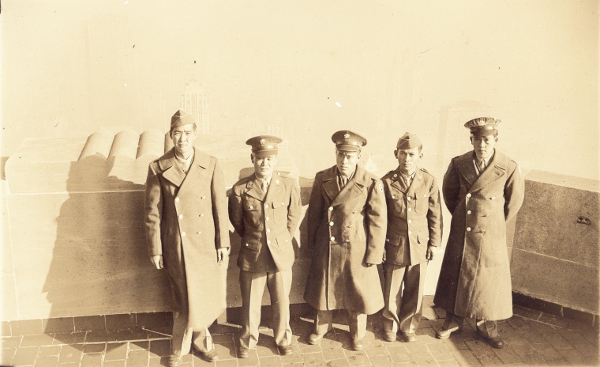
Their stay at Camp McCoy was filled with new adventures and experiences. For most of the men, this was their first time on the U.S. mainland, and also the first time they had ever seen snow. They used their furloughs to visit major cities they had previously only heard or read about, including Chicago, New Orleans, New York City, and Washington, D.C.
For the most part, residents of nearby Sparta and La Crosse — many of them immigrants or children of immigrants who had themselves experienced discrimination in the past — took to the easy-going men from Hawaiʻi. They invited them to home-cooked dinners, church socials, and dances, and played a variety of sports with them. Lifelong friendships would develop during the 100th’s time at Camp McCoy. [Read more: Wisconsin Stories]
In unit meetings, Colonel Turner sometimes scolded the men for overindulging in Wisconsin beer or attempting to bribe camp guards with sandwiches and drinks when returning late from leave. He reminded them that it was important to uphold the battalion’s good reputation.
The 1,400-plus soldiers of the 100th Infantry Battalion were not alone at Camp McCoy. They shared the 14,000-acre training facility with trainees from a military police battalion, a quartermaster detachment, and some construction workers. Some scuffles occurred, but the men of the 100th — many of them in fine physical condition and some excelling in martial arts — held their own against larger soldiers.
![Camp McCoy Barracks, October 1942 [Courtesy of Fumie Hamamura]](https://www.100thbattalion.org/wp-content/gallery/battalion-history-mainland-training/hamamura_stanley_122.jpg "Camp McCoy Barracks, October 1942 [Courtesy of Fumie Hamamura]")
The battalion remained housed in tents from its arrival in June until new barracks at Camp McCoy were completed in September 1942. Many of the men experienced their first snowfall while still living in tents.
Even with many new experiences occupying their time, the men of the 100th were already thinking ahead to the future. The idea of forming a postwar organization where they could preserve their bonds and continue to gather as a group gained strong support. Dr. Katsumi Kometani, the battalion’s morale officer, is credited by Executive Officer Major James Lovell as the one who first raised the concept. Members of the battalion voted to accept the proposal and establish a fund for a future veterans’ club and clubhouse. From that point on, two dollars in dues was deducted from each member’s monthly pay by company clerks, who handled the collection and record-keeping.
As the amount increased, concerns arose about its protection and management. The battalion decided to place the funds in the care of Charles Hemenway, a well-known Honolulu community figure and supporter of the Japanese community in Hawaiʻi, who would hold and eventually invest the money until the men returned home. After the war, these funds would serve as seed money to purchase property for the clubhouse of the organization they would name Club 100.
The Secret Mission on Cat Island
![Kenneth Iwashita and Yasuo Takata row out to Cat Island [Courtesy of William Takaezu]](https://www.100thbattalion.org/wp-content/gallery/battalion-history-mainland-training/takaezu_william_167.jpg "Kenneth Iwashita and Yasuo Takata row out to Cat Island [Courtesy of William Takaezu]")
In November 1942, while the rest of the 100th continued training at Camp McCoy, 25 enlisted men from 3rd Platoon, Company B, along with a cook from Headquarters Company and three officers, were selected for a secret assignment on Cat Island, a small island off the coast of Mississippi. The War Department had received a proposal suggesting that dogs could be trained to identify and attack Japanese soldiers by scent, which proponents believed would be especially useful in combat in the Pacific theater. The B Company soldiers were chosen to test the theory.
In the book Japanese Eyes…American Heart: Personal Reflections of Hawaii’s World War II Nisei Soldiers, participant Raymond Nosaka recalled having his right arm wrapped in protective gear before facing the attack dogs:
“The dogs were trained to leap and attack the soldier’s throat. I was taught to quickly place my wrapped arm over my throat and then wrestle with the dog until the trainer commanded him to ‘stop’ or ‘kill.’”
![Cat Island and Ship Island Gang, Mississippi, 1942, Bottom row, L to R: William Takaezu, Tokuji Ono, James Komatsu, Fred Kanemura, Koyei Matsumoto, Yasuo Takata. Middle row, L to R: Unknown, Robert Takashige (with hat), Seiji Tanigawa, John Kihara, Yukio Yokota (with arm on Kihara's shoulder). Top row, L to R: Seiei Okuma, Takeshi Tanaka (arms around man in front of him), unknown, Masao Hatanaka, Katsumi Maeda, Ray Nosaka, Robert Goshima (standing). [Courtesy of Raymond Nosaka]](https://www.100thbattalion.org/wp-content/gallery/nosaka_raymond/nosaka_raymond-004x.jpg "Cat Island and Ship Island Gang, Mississippi, 1942, Bottom row, L to R: William Takaezu, Tokuji Ono, James Komatsu, Fred Kanemura, Koyei Matsumoto, Yasuo Takata. Middle row, L to R: Unknown, Robert Takashige (with hat), Seiji Tanigawa, John Kihara, Yukio Yokota (with arm on Kihara's shoulder). Top row, L to R: Seiei Okuma, Takeshi Tanaka (arms around man in front of him), unknown, Masao Hatanaka, Katsumi Maeda, Ray Nosaka, Robert Goshima (standing). [Courtesy of Raymond Nosaka]")
For the next four months, the men divided their time between fishing, relaxing, and serving as “dog bait” in the Army’s experiments. The project ultimately failed to produce reliable results and was deemed a failure. The men later rejoined the 100th, which had by then transferred to Camp Shelby in Mississippi, for advanced training.
The men assigned to the Cat Island project included Major James Lovell, who escorted the group to the site; Lieutenants Rocco Marzano and Ernest Tanaka; and Herbert Ishii of Headquarters Company, who served as the cook.
The 24 soldiers from the Third Platoon, Company B were: Robert Goshima, Masao Hatanaka, Noboru Hirasuna, Tadao Hodai, Masami Iwashita, Fred Kanemura, John Kihara, Tokuichi Koizumi, James Komatsu, Katsumi Maeda, Koyei Matsumoto, Toshio Mizusawa, Taneyoshi Nakano, Raymond Nosaka, Seisho Okuma, Tokuji Ono, Robert Takashige, Seiji Tanigawa, William Takaezu, Takeshi Tanaka, Patrick Tokushima, Yasuo Takata, Mac Yazawa, and Yukio Yokota.
The Cat Island mission remained largely secret for decades, but a number of veterans later shared their experiences through interviews, articles, oral histories, and photographs. These firsthand accounts provide important insight into one of the most unusual and controversial episodes in the history of the 100th Infantry Battalion.
- A Bastard Outfit – What Else?” Puka Puka Parade interview with James Lovell (HQ) by Ben Tamashiro (Co. D) (Jan.–Feb. 1980, pages 5-15)
- “The Secret Mission of the Third Platoon, Baker Company”: Puka Puka Parade article written by two of the participants Yasuo Takata and Raymond Nosaka (March–April 1980, pages 21 – 27)
- William Takaezu’s Cat Island photo collection
Military Intelligence Service Transfers
![Graduates of the MIS linguist training program at Camp Savage, Minnesota, 1943. [Courtesy of Florence Matsumura]](https://www.100thbattalion.org/wp-content/gallery/photos-mainland-training/matsumura_tom_012.png "Graduates of the MIS linguist training program at Camp Savage, Minnesota, 1943. [Courtesy of Florence Matsumura]")
While at Camp McCoy, the 100th Infantry Battalion was visited by a Military Intelligence Service (MIS) recruitment team. Recruiters had been visiting incarceration camps seeking AJA soldiers bilingual in Japanese and English, and they also recruited members of the 100th who were proficient in Japanese. Several dozen men from the battalion volunteered to serve in the MIS, while a few were ordered to transfer despite wanting to remain with the rest of the unit at Camp McCoy. Others, despite their bilingual abilities, were allowed to stay with the 100th.
Members of the battalion were tested and interviewed by the MISLS team at Camp McCoy to determine their Japanese-language ability. In addition to those selected for MISLS, a memo dated July 5, 1942, from Colonel Kendall J. Fielder of the Hawaiian Department to War Department officials in Washington listed 69 soldiers serving in the 100th who had qualified in spoken Japanese-language ability despite scoring below the required grade of 70 on Japanese translation tests. The memo also emphasized that all of the men had undergone loyalty investigations and that “nothing suspicious” about them was known.
In late November 1942, about 60 soldiers from the 100th were transferred to the Military Intelligence Service Language School (MISLS) at Camp Savage, Minnesota, to train as interpreters, translators, interrogators, and intelligence specialists. Roughly 10 days later, a second contingent from the battalion followed. Additional recruits were needed because volunteer quotas from the incarceration camps had not been filled. Together with the first group, the men from the 100th became part of what was later known as the “senpai-gumi,” or senior cohort, regarded as the forerunners who helped establish the foundation for later MISLS trainees.
Earlier graduates of the MISLS had already demonstrated the value of battlefield linguists. Most of these AJA soldiers were Nisei who had grown up speaking Japanese at home, or Kibei-Nisei — American-born Japanese who had spent part of their upbringing or education in Japan. At Camp Savage, they underwent intensive training in Japanese military terminology. In the field, they translated captured enemy documents and intercepted communications, interrogated prisoners of war, and gathered intelligence. The success of these bilingual soldiers prompted the Army to urgently recruit additional Japanese American linguists for the MISLS.
Unlike the group sent to Cat Island, these men would not return to the 100th after completing their MISLS training. Instead, they became part of what would later be called “America’s secret weapon,” serving primarily in Asia and the Pacific theater. Many served on remote islands in the South Pacific and in Australia, usually in small detachments. A few were assigned to the Pentagon or performed military duties in installations across the mainland United States.
![(December 25, 1942) Sgt. Kenneth Yoshiura (left) and S/Sgt. Kawakami (right) at Camp Savage, Minnesota. [Courtesy of Joanne Kai]](https://www.100thbattalion.org/wp-content/gallery/photos-mainland-training/Kawakami-Masanobu-Eugene-image26-1942-1225-Camp-Savage-Kawakami-Yoshiura-CX.png "(December 25, 1942) Sgt. Kenneth Yoshiura (left) and S/Sgt. Kawakami (right) at Camp Savage, Minnesota. [Courtesy of Joanne Kai]")
At the end of December 1942, a few members of the 100th traveled to Camp Savage for a weekend visit with their friends who had just transferred. There, they were surprised to learn they were expected to speak only Japanese — a contrast to Camp McCoy, where they were discouraged from speaking the language.
Club 100 records have identified about 80 men who served in the Military Intelligence Service after being originally assigned to the 100th Infantry Battalion. In 1943 at Camp Shelby, Mississippi, a smaller group from the 100th was transferred to MISLS prior to the unit’s deployment to the European Theater. In addition, a few soldiers from the 100th later returned from combat and were assigned to MIS in 1944 and 1945. The men of the 100th who served in MIS performed their duties exceptionally well and were highly regarded for both their bilingual abilities and their effectiveness as soldiers.
MIS AJA linguists served in every major campaign against Japan beginning in 1942, often at great personal risk due to being mistaken for the enemy, and were widely credited with saving countless lives and helping shorten the war through their intelligence work. Much of their service remained classified during and after the war, and for years their extraordinary contributions were not widely recognized or documented, only later emerging as restrictions were lifted and veterans were finally able to share their experiences, leaving a limited but important record of firsthand accounts that reflects their remarkable impact in both the war and the postwar occupation of Japan.
- “Senpai-gumi”: Memoirs by Richard Oguro (1982)
- “A Kibei in the Burma Jungle”: Article by Roland Kotani (The Hawaii Herald, Nov. 6, 1981)
- “Kazuo Yamane’s Key Discovery”: Article by Ben Tamashiro (Co. D) (The Hawaii Herald, Jul. 2, 1993)
- “WW II Experiences – Pentagon, Paris, Berlin”: Article by Kazuo Yamane (100th/MIS) (Club 100 45th Anniversary Reunion, June 1987)