
The men of the 100th Infantry Battalion never forgot their comrades who were killed in combat or died in service. Bound by service and by hometowns, with most of its members from Hawai‘i, many had grown up together, attended the same schools, and played on the same sports teams, remaining close long after the war. In such a close-knit unit, the loss of each soldier was deeply personal; every name etched in stone was a familiar face — a friend, a brother — remembered for the rest of their lives.
View Names and Profiles of 100th Infantry Battalion Soldiers Who Died in Service
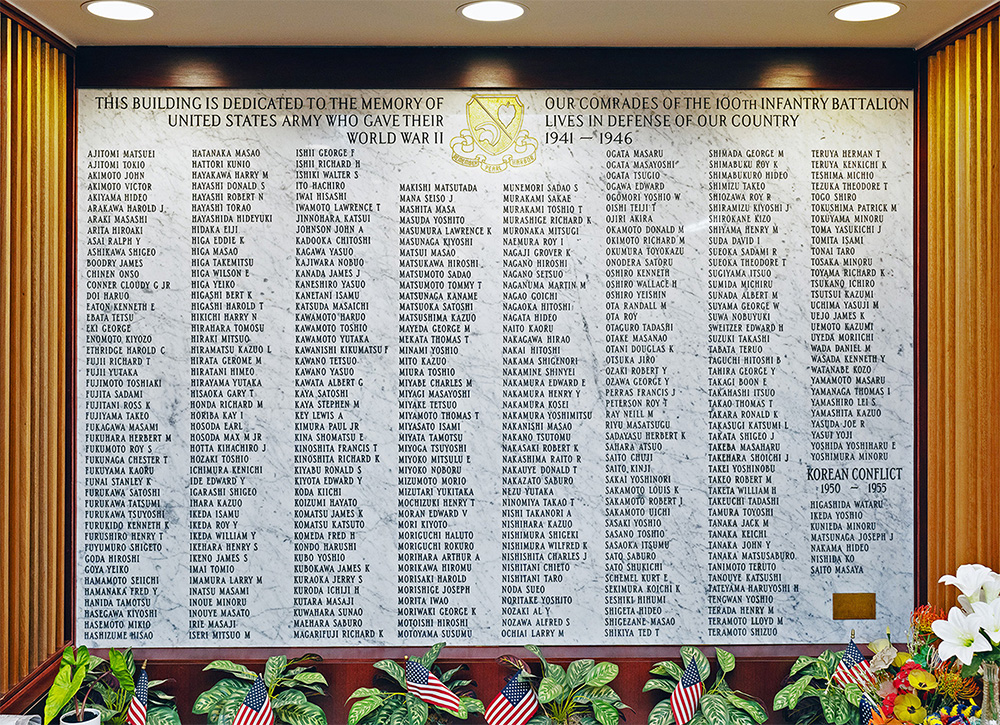
Memorial Building and Plaque. In 1952, the 100th Infantry Battalion Memorial Building (Club 100 Clubhouse) in Honolulu was completed with funds collected from the 100th soldiers during their time in training and combat.
In 1958, a single marble slab was imported from Carrara, Italy — a region where the battalion had fought on the Gothic Line — and inscribed with the names of the 338 soldiers* who died during World War II, along with seven more who later died in the Korean War. Carved at the top of the marble wall are the words: “This building is dedicated to the memory of our comrades of the 100th Infantry Battalion – United States Army who gave their lives in defense of our country – World War II 1941–1946.”
The marble plaque, recorded as measuring 64 by 100 inches and weighing about 900 pounds, was unveiled at a dedication ceremony held at the Clubhouse on September 28, 1958, following the annual memorial service for the 100th Infantry Battalion at the National Memorial Cemetery of the Pacific (Punchbowl Cemetery). In his dedication address, the battalion’s first commander, Lt. Col. Farrant L. Turner, said the club was fulfilling “the solemn pledge we made years ago” to honor the memory of their comrades who gave their lives in service during the war.
This memorial wall stands as a solemn testament to their courage, sacrifice, and the deep bond of loyalty and love they shared with one another.
![Chaplain Yost and Kenneth Otagaki. [Courtesy of University of Hawaii JA Veterans' Collection]](https://www.100thbattalion.org/wp-content/gallery/chaplain-yost/yost-2x.jpg "Chaplain Yost and Kenneth Otagaki. [Courtesy of University of Hawaii JA Veterans' Collection]")
Memorial Services. Remembrance began well before the Clubhouse was built. In 1947, the battalion’s chaplain, Israel Yost, visited Hawai‘i and traveled across the territory conducting memorial services on different islands.
On September 1, 1948, the Dalton Victory arrived in Honolulu Harbor carrying the remains of 79 island soldiers — 34 from the 100th Infantry Battalion — from overseas cemeteries. Representatives of the 100th Infantry Battalion, the 442nd Regimental Combat Team, and the Military Intelligence Service boarded a Coast Guard cutter to greet the ship, gently tossing floral wreaths into the ocean as it passed Diamond Head. Onshore, many uniformed veterans waited on the piers, joined by members of the community, in silent tribute. Interment ceremonies followed at the newly opened National Memorial Cemetery of the Pacific and in county cemeteries on the other islands.
Every year, this legacy of remembrance continues. On September 29, 1946, the veterans of the 100th Infantry Battalion held a memorial service in Hawaii to honor their comrades who had died in the war. Through their postwar organization, Club 100, the veterans continued to organize and participate in an annual memorial service honoring their fallen comrades, held on the Sunday in September closest to September 29 — the date in 1943 when Sgt. Shigeo “Joe” Takata (Co. B) became the first member of the unit to be killed in action.
Today, the families and members of the 100th Infantry Battalion Veterans (Club 100) continue this tradition. Since 2006, it has been held as a joint memorial service honoring all who served in the 100th Infantry Battalion, the 442nd Regimental Combat Team, the Military Intelligence Service, and the 1399th Engineer Construction Battalion, recognizing those who died in World War II or have since passed.
Honoring the Fallen Across the World. The legacy of the 100th Infantry Battalion’s sacrifice reaches far beyond Hawaii. Some of the soldiers who died in the war are buried in cemeteries on the mainland United States and in American military cemeteries in Europe. The bodies of six soldiers were sent to their parents who had returned to Japan.
In 1962, during the first Club 100 group tour to Japan, 100th veterans participated in an elaborate memorial service at Ryōzen Kannon, a war memorial in Higashiyama, Kyoto, dedicated to Japanese and foreign World War II soldiers who died in service to their countries.
Over the years, veterans and their families have traveled to Italy and France, visiting cemeteries and memorials maintained by the American Battle Monuments Commission (ABMC) to honor the 100th and 442nd soldiers interred there, as well as those commemorated on the Walls of the Missing.
- At the Sicily-Rome American Cemetery near Nettuno, Italy, 100th Infantry Battalion soldiers John “Jack” Johnson (HQ), Lewis A. Key (Co. A), Edward V. Moran (Co. B), Neill Ray (Co. D), and Kurt E. Schemel (Co. E) are buried, while Daniel Anderson (Co. B), Sunao Thomas Kuwahara (Co. C), and Toshio Sasano (Co. A) are memorialized on the Tablets of the Missing.
- At the Florence American Cemetery, Edward Sweitzer (Co. B), Boon Takagi (Co. C), Charlie Fujiki (Co. C), and Noboru Miyoko (Co. B) of the 100th Infantry Battalion are buried. In addition, Fred Fritzmeier, Clifford Hana, Tadao Hayashi, Robert Kishi, Benjamin Ogata, Ralph Potter, Jimmie Taketa, John Yamamoto, and Setsuro Yamashita of the 442nd RCT are also buried there.
- At the Épinal American Cemetery, outside Bruyères, France, 100th Infantry Battalion soldiers Mitsuru Miyoko (Co. A), Tomosu Hirahara (Medics), Edward Ogawa (Co. C), and Yoshio Tengwan (Co. C) are buried, while George Suyama (Co. A) is memorialized on the Tablets of the Missing. Also buried there are Joseph Byrne, Teruo Fujioka, Bob Kameoka, Hachiro Mukai, Ben Rogers, Uetaro Sanmonji, Hideo Yasui, and Minoru Yoshida of the 442nd RCT.
- At the Lorraine American Cemetery, brothers John Akimoto (Co. C) and Victor Akimoto (Co. A) of the 100th/442nd are buried.
- 100th Infantry Battalion soldier Itsumu Sasaoka (Co. A) is memorialized on the Tablets of the Missing at the Netherlands American Cemetery.
Continuing the Legacy. The legacy of these soldiers lives on through the stories told by their families and communities, ensuring that each life and sacrifice continues to be remembered. Besides the three stories located in this section about Matsuei and Tokio Ajitomi (Co. C), Kiyoshi Jimmie Shiramizu (Medics), and Hideyuki Hayashida (Medics), the special Hawaii Herald issue commemorating the 50th anniversary of the 100th included three stories about men from Oahu, Maui and Kauai who were killed in action. Guided by the 100th veterans, who maintained a steadfast commitment to honoring their comrades, Club 100 continues their work, ensuring that the courage and sacrifice of the men of the 100th are never forgotten.
—–
* Note: While the Memorial Wall lists 338 names of men in the 100th who died during World War II, later research determined that 340 men were killed in combat or while serving in the 100th Infantry Battalion.
At least two men died on the mainland where the battalion had been assigned for training. Larry Ochiai of C Company died on June 23, 1942, in the Tomah Hospital after an appendectomy operation while the battalion was at Camp McCoy, Wisconsin. Paul Kimura, also of C Company, died on July 6, 1943, at Camp Shelby, Mississippi. Yukitaka Mizutari is included on the Memorial Wall, but he had transferred from the 100th Infantry Battalion (Separate) to the Military Intelligence Service while at Camp McCoy and was killed in action in New Guinea.
Years later, it was discovered that one name had been incorrectly included on the plaque. This came to light when Kozo Watanabe (Co. C) traveled from the mainland to attend a battalion reunion and visited the Clubhouse. Another veteran, Stanley Akita (Co. C) of Honolulu, had been captured during the war, at the same time as Watanabe. Since Akita did not see Watanabe again after they were prisoners of war, he had assumed that Watanabe had been killed.
Profiles from the “Echoes of Silence” project were added to the website in 2020, revealing additional discrepancies. Kay I. Horiba’s (Co. C) name was inscribed on the marble memorial in the clubhouse, though he had survived the war. Five mainland-born soldiers — Daniel Anderson (Co. B), Daniel Tsukamoto (Co. D), Charles Fujiki (Co. C), George Sawada (Medics), and Tatsuo Yoshizaki (Co. C) — were not included in the original listing of those who died in the 100th.