
Setting the Stage
On September 2, 1943, the 100th Infantry Battalion (Separate) landed in Oran in French Algeria, North Africa. Despite their extensive training and capabilities, it was suggested that the battalion could be assigned to guard rail lines and supply depots in North Africa. Lieutenant Colonel Farrant L. Turner, commander of the 100th Infantry Battalion (Separate), who repeatedly demanded respect for his men, insisted that they be committed to combat duty. He knew his soldiers wanted the opportunity to prove themselves in combat.
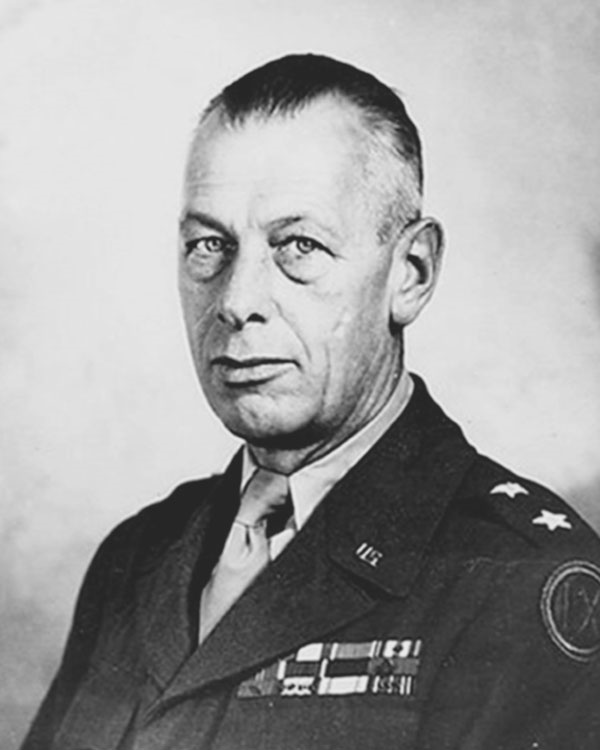
Major General Charles W. Ryder, commander of the 34th Infantry Division, asked Turner about the caliber of his Nisei soldiers. Turner expressed complete confidence that they were as good as any of the other troops, and Ryder accepted his assurance, committing the 100th to combat.
Following the return of Lt. Col. Turner and Major James Lovell from meetings at headquarters, the men of the 100th learned that they would be attached to the 133rd Infantry Regiment of the 34th Infantry Division. The 100th would replace the regiment’s 2nd Battalion, which was serving as a special military guard at General Dwight D. Eisenhower’s headquarters in Oran. The 100th retained its own identity and designation as the 100th Infantry Battalion (Sep) rather than being redesignated as the “2nd Battalion, 133rd Infantry.”
Known as the “Red Bull” Division and inspired by its motto, “Attack, Attack, Attack,” the 34th Division was the first U.S. Army division to sail overseas to Europe after the United States entered World War II. By the time the 100th was attached to the division, the 34th had already suffered heavy losses fighting German forces in North Africa.
The 100th moved into the 34th Division’s bivouac area and was warmly welcomed by the 133rd Infantry Regiment. That evening, the soldiers gathered together, singing songs, sharing wine, and enjoying fellowship. By the end of the evening, a bond had been established between the two units.
The 34th Infantry Division was part of the U.S. Fifth Army commanded by General (then Lieutenant General) Mark W. Clark, one of the few senior commanders willing to accept the 100th into his command when others had not. After receiving instruction on German tactics and land mine warfare, the 100th Infantry Battalion (Separate) and the 34th Infantry Division sailed together for Italy aboard the S.S. Frederick Funston on September 19, 1943.
They landed on the beaches of Salerno in southern Italy on September 22, 1943. At that time, the 100th numbered just over 1,300 men.
Although Italy announced an armistice with the Allies on September 8, 1943, German forces quickly disarmed Italian troops and continued to occupy and defend key positions throughout the Italian peninsula. As Allied armies advanced northward, German forces conducted a fighting withdrawal, establishing a series of fortified defensive lines anchored by rivers, mountains, and other natural obstacles. They remained entrenched on mountains overlooking key valleys and roads, and German engineers made extensive use of Italy’s rugged terrain, constructing bunkers, artillery positions, minefields, and other fortifications that made each Allied advance costly.
The major objectives of the Allied forces, led by Clark’s U.S. Fifth Army, were to push north, capture Rome, and defeat the German forces in Italy. However, the rocky terrain, snow, mud, rain, and freezing temperatures created constant obstacles and often made the deployment of heavy artillery impossible, costing the men vital support. Deadly land mines and booby traps were scattered throughout the countryside. These harsh conditions also resulted in limited food and supplies and timely medical assistance for the wounded.
The men from Hawaiʻi additionally suffered from the initial lack of warm clothing — the Quartermaster Corp was still having difficulties finding clothing and boots small enough for many of the AJA (American of Japanese ancestry) soldiers.
From their arrival in Italy in September 1943 until the end of the war in Europe in May 1945, the 100th Infantry Battalion fought in six major campaigns and established a reputation for extraordinary courage and sacrifice. The battalion would be joined in combat by the 442nd Regimental Combat Team in June 1944, and officially redesignated the 100th Battalion, 442nd Infantry on August 10, 1944. Together, the 100th and 442nd would become one of the most highly decorated units in United States military history.