
The youngest of eight siblings who survived into adulthood—was born on January 15, 1920, on the island of Oahu, in an era when birth certificates were not yet routinely issued. He did not obtain an official birth record until 1992, when he applied for a passport for a return visit to Monte Cassino.
To anyone who knew him only from his later years on the East Coast, it might have come as a surprise that he had once been an avid surfer, crafting his own longboards and spending nights on the slopes of Tantalus as a boy.
By December 7, 1941, Irving was a member of the Hawaiian National Guard, having been drafted just a month earlier. He happened to be on leave that day. In the tense aftermath of the attack on Pearl Harbor, as suspicion and discrimination intensified toward Japanese Americans, he and his fellow islanders were sent to Camp McCoy for training before deploying to Europe.
Akahoshi fought in some of the most grueling campaigns of World War II. During the brutal battle for Monte Cassino, 26 men began the day in the battalion’s observation post; by nightfall, only four remained unwounded. Private Irving Akahoshi was among those four—the rest were dead or injured. This level of sacrifice became tragically common for the 100th Infantry Battalion, which earned the grim nickname “The Purple Heart Battalion.” Irving himself received the Purple Heart, as well as the Bronze Star, the Combat Infantry Badge, and the Distinguished Unit Badge. In characteristic Nisei humility, his medals spent the rest of his life stored in a shirt box in the bottom drawer of a dresser.
In 1992, returning to Italy to see in peacetime the ground he had once crawled across under fire, Irving stood at Monte Cassino and, with typical understatement, remarked, “This is it?!”
Irving also participated in the daring reconnaissance mission of May 16, 1944, for which both he and Lt. Young Oak Kim received the Distinguished Service Cross. Irving described the event simply as “we captured a couple Germans with some important information,” but the reality was far more perilous: an hours-long daylight crawl deep into enemy territory. The intelligence they secured helped break German defenses at Anzio and open the road to Rome. Both men also received the Italian Medal of Military Valor (Medaglia al Valore Militare) for their outstanding gallantry.
After the war, Irving spent time in Chicago—sharing an apartment with other veterans—and later returned to Hawaii. There he worked at Miyamoto Jewelry, discovering the creative vocation that eventually led to a cross-country move to New York in 1956 with his wife, Fudeko Naka, whom he had married the previous year. New York also brought him closer to one of his lifelong passions: live opera.
All three of the Akahoshi children were born in New York. In the early 1960s, the family joined the wave of city dwellers moving to the suburbs, settling in New Jersey. Irving remained there until the mid-1990s, when, widowed, he moved to Laguna Hills, California, to be closer to family.
He maintained close ties to the 442nd and 100th communities throughout his life, including the Go for Broke Club in New York City and longtime friendships with the Kogas, Konnos, Kochiyamas, Ishiis, Bjorks, and many others—mostly fellow 442nd veterans or families from the islands. In retirement he visited Hawaii more frequently, reconnecting with old friends at Club 100 and renewing the bonds forged in wartime.
Irving Mitsuo Akahoshi died on November 19, 2001, and is buried at Arlington National Cemetery.
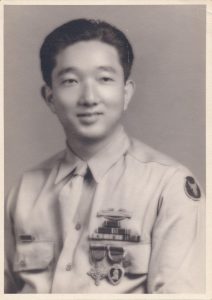
Courtesy of Corinne Akahoshi