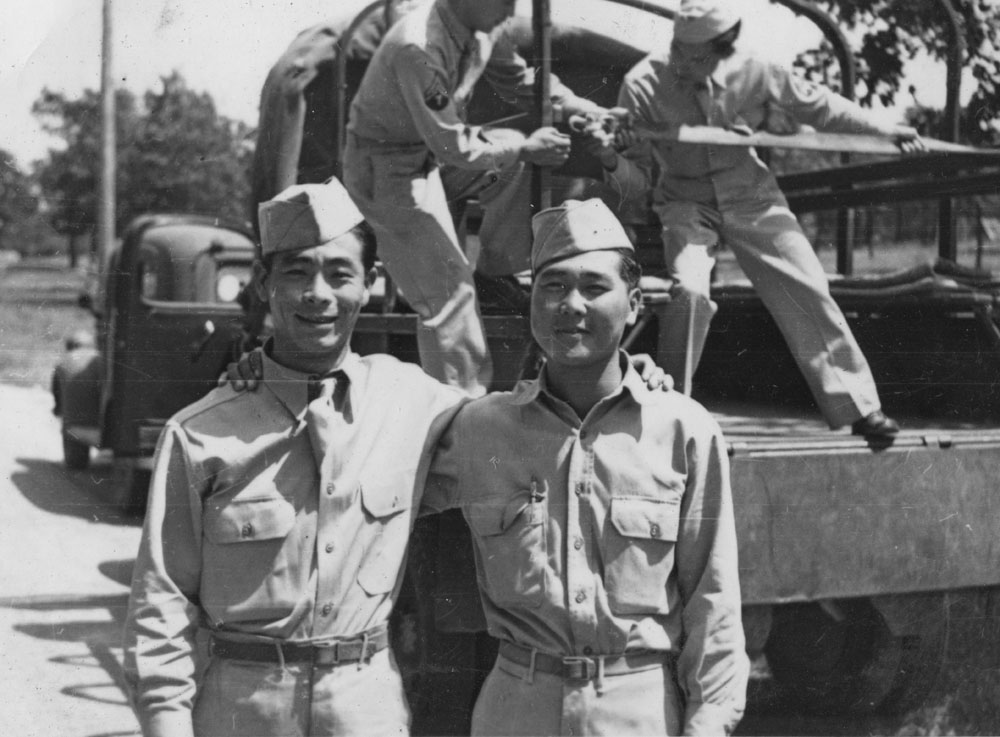
Charlie Company, 100th Infantry Battalion
Mike Nobuo Tokunaga was born the eldest of five children in 1920 in Lāhainā, Maui and graduated from Lāhaināluna High School. His plan was to work in the sugarcane fields to earn money to pay for college, but he was drafted in November 1941.
![Mike N. Tokunaga (Co. C, 100th Inf. Bn.) [Courtesy of Club 100]](https://www.100thbattalion.org/wp-content/gallery/tokunaga_mike/Tokunaga-Mike-N.png "Mike N. Tokunaga (Co. C, 100th Inf. Bn.) [Courtesy of Club 100]")
In June 1942, Tokunaga reported to Camp Paukūkalo and learned he was being assigned to a segregated unit — the Hawaiian Provisional Infantry Battalion — formed from Americans of Japanese ancestry who had been removed from their multiethnic units after Pearl Harbor. He sailed to the mainland as an original member of the battalion, which arrived in Oakland, California, where it was redesignated as the 100th Infantry Battalion (Separate).
Tokunaga trained at Camp McCoy in Wisconsin, and later Camp Shelby in Mississippi. He entered combat with the 100th in Italy in September 1943, where he proved his steadiness under fire. He received three Purple Hearts for wounds suffered in action and earned the rank of Staff Sergeant. Like so many men of the 100th, he rarely spoke in detail about his injuries, emphasizing instead the loyalty and courage of the soldiers around him.
After the war, Tokunaga enrolled at the University of Hawai‘i, graduating with a business administration degree. He was immediately hired by the State of Hawai‘i Labor Department as a veterans’ counselor, helping hundreds of returning servicemen navigate education benefits, employment, and the difficult transition back into civilian life. His capacity for organization and his calm, thoughtful manner made him a natural leader.
He later worked as a field representative for the Hawai‘i Government Employees’ Association and, in time, Governor John A. Burns appointed him Deputy Director of Regulatory Agencies. Tokunaga went on to serve as Deputy Comptroller, working under Governor Burns for 12 years and under his successor, Governor George Ariyoshi, for another 12 years. His career in public administration spanned more than two decades, marked by integrity, competence, and quiet dedication.
Tokunaga also played a crucial behind-the-scenes role in Hawai‘i’s political transformation. Although the 100th Infantry Battalion veterans were generally older than their 442nd counterparts, they were deeply influential in organizing the Democratic Party of Hawai‘i. Tokunaga was among the key planners who helped Burns build the networks that ultimately fueled the Democratic Revolution of 1954. Working shoulder-to-shoulder with figures such as Dan Aoki and Dan Inouye, he helped shape a movement that opened political power to working people, immigrants’ children, and the veterans who had proven their loyalty in war.
Within Club 100 — the veterans’ organization dedicated to “For Continuing Service,” Tokunaga remained a respected figure. Tokunaga served as Club 100’s president in 1984, helping preserve the battalion’s legacy and supporting efforts that strengthened Hawai‘i’s civic life.
Reflecting decades later, Tokunaga acknowledged that the 100th men, older and already rooted in prewar affiliations, joined both political parties. But whatever their differences — Republican or Democrat — the veterans shared a commitment to improving Hawai‘i through public service.
Mike Tokunaga embodied that ideal. From the battlefield to the Capitol, from counseling veterans to building a better government, he lived a life defined by service, humility, and the enduring bonds of the 100th Infantry Battalion.
In the Hawaii Herald issue of June 19, 1992, a special issue commemorating the 50th anniversary of the 100th’s formation, Arnold Hiura wrote an article about the veterans, including Mike Tokunaga, who became involved in public service after the war.
Read Hawaii Herald Article by Arnold Hiura
100th veteran Ben Tamashiro interviewed Tokunaga. His article, “Mike Tokunaga: The ‘Organizer’ Who Helped Build the Democratic Party,” appeared in the January 1986 issue of the Hawaii Hawaii and was later reprinted in a “Puka Puka Parade” issue.
Read Hawaii Herald article by Ben Tamashiro
![Mike Tokunaga Chicago, 1942. [Courtesy of Betty Tokunaga]](https://www.100thbattalion.org/wp-content/gallery/tokunaga_mike/tokunaga_mike-001x.jpg "Mike Tokunaga Chicago, 1942. [Courtesy of Betty Tokunaga]")
![Ready to board train at Camp McCoy, Wisconsin [Courtesy of Betty Tokunaga]](https://www.100thbattalion.org/wp-content/gallery/tokunaga_mike/tokunaga_mike-002x.jpg "Ready to board train at Camp McCoy, Wisconsin [Courtesy of Betty Tokunaga]")
![Sept 1942, Co. C, 100th Inf. Bn. Camp McCoy, Wis. [Courtesy of Betty Tokunaga]](https://www.100thbattalion.org/wp-content/gallery/tokunaga_mike/tokunaga_mike-005x.jpg "Sept 1942, Co. C, 100th Inf. Bn. Camp McCoy, Wis. [Courtesy of Betty Tokunaga]")