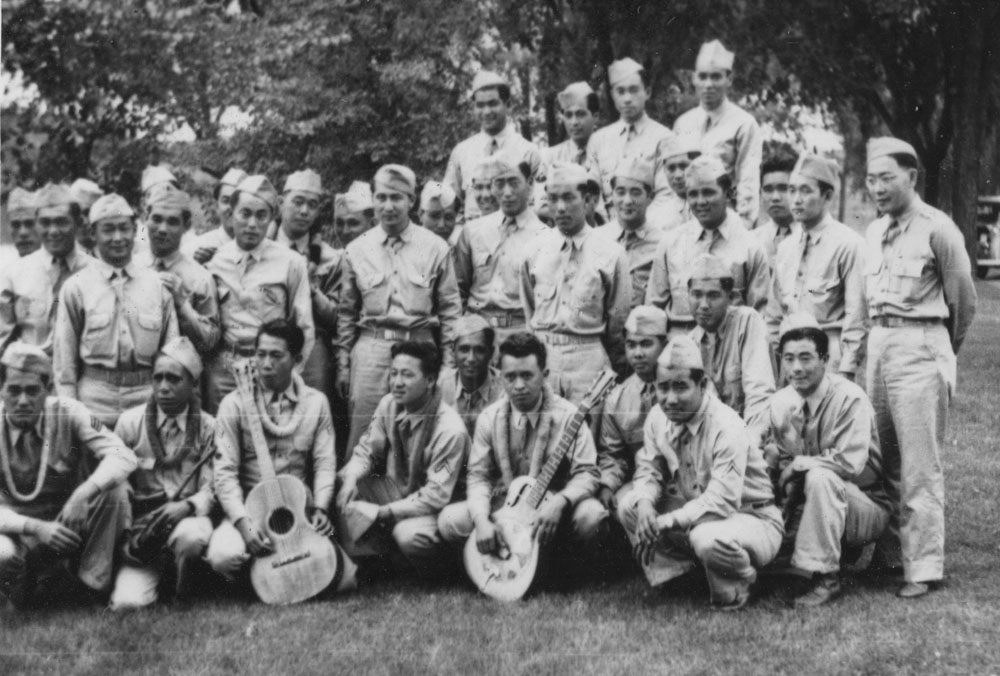
Charlie Company, 100th Infantry Battalion
Kazuto “Kazu” Shimizu was born on March 3, 1924, on the island of Hawaiʻi, and raised in the plantation town of Pāhoa in a large, close-knit family that understood the value of hard work. His grandfather was a carpenter for ʻŌlaʻa Plantation, and his father was a part-time sugarcane planter who also worked for the plantation when he was not tending his own small field. Though the family had limited means, Kazuto remembered that they were “never hungry.”
![Kazuto Shimizu (Co. C, 100th Inf. Bn.) [Courtesy of Kazuto Shimizu]](https://www.100thbattalion.org/wp-content/gallery/shimizu_kazuto/Shimizu-Kazuto.png "Kazuto Shimizu (Co. C, 100th Inf. Bn.) [Courtesy of Kazuto Shimizu]")
His parents’ determination gave him a chance at an education — he was able to attend high school thanks to the money raised by the family’s backyard chicken farm, though Kazuto joked that he was determined never to become a chicken farmer because of the smell.
When Japan attacked Pearl Harbor on December 7, 1941, Kazuto was a senior at Hilo High School. The war abruptly halted his education, and Hawaii fell under martial law. Soldiers soon arrived on the island, and Kazuto recalled how his family befriended two who regularly visited their home, unaware they were on their way to Guadalcanal. That early brush with war foreshadowed what lay ahead for him.
In March 1943, when the U.S. Army called for Japanese Americans to volunteer for military service, 19-year-old Kazuto stepped forward. His father told him that if he wanted to go, to go ahead; his mother remained very quiet.
On March 27, the day he was inducted into the Army, his mother stood by him throughout the ceremony for the Big Island inductees in Hilo. As the Army truck began to move and carry him away, she reached for his hand and waved goodbye until they could no longer see each other — a moment Kazuto would never forget.
After a ceremony at the ʻIolani Palace grounds in Honolulu, Kazuto joined the 442nd Regimental Combat Team for training at Camp Shelby, Mississippi. There, Hawaii recruits and mainland Japanese Americans — nicknamed “buddhaheads” and “kotonks” — began to train together for combat. Kazuto was in the 1st platoon, Company F, 2nd Battalion, 442nd RCT, and excelled as a rifleman and scout, earning the rank of expert marksman.
Before long, he was transferred to the 100th Infantry Battalion in Italy as part of the first group of replacements sent to reinforce the unit of Americans of Japanese ancestry, which had been fighting in Europe since September 1943. Kazuto later recalled:
“There was no fanfare when I left the 442nd to be transferred to the 100th. There was a notice posted on the company bulletin board listing those selected to go. I believe there were three names from F Company and I was one of them. When I left the company only one person came to see me off. Tadao Nakamura rushed back from training to say goodbye. Later and eventually the 442nd and the 100th were fighting together in Italy. Whenever the 442nd was out of combat area I made it a point to visit F Company and wish Tadao well. Tadao was not there after the battle at “Hill 140”. It was a sad day for me.”
By the time he arrived, the battalion was near the town of Benevento, and had been reduced by heavy casualties from about 1,300 men to around 400.
As part of Company C in the 100th Infantry Battalion, Kazuto fought in Italy’s brutal battles from Anzio to Rome, then later in France, and back again in Italy. Kazuto’s service carried him through some of the 100th and 442nd’s most storied battles — the liberation of Bruyères, the rescue of the “Lost Battalion,” and the final offensive at the Gothic Line in Italy. He witnessed unimaginable destruction and loss, including the deaths of close comrades, yet continued to fight with courage and resolve. He survived countless near-misses: unexploded shells, enemy ambushes, and relentless artillery fire.
Kazuto attained the rank of Staff Sergeant in the 100th. He was one of five siblings with two sisters and two brothers who served in the Korean War. When Germany surrendered in 1945, he returned home after three years of war, arriving in Honolulu on Christmas Eve. That night, startled by firecrackers, he and his friend Tom Miyoken (Co. C) instinctively dove to the ground — a reminder that the echoes of war still lingered within them.
After the war, Kazuto continued his education with the support of the G.I. Bill, earning a degree in civil engineering from the University of Hawaiʻi. He was then hired at the Pearl Harbor Naval Shipyard, where the Navy trained University of Hawaiʻi civil engineering graduates as naval architects. As part of this program, he attended summer courses in marine engineering and naval architecture at UC Berkeley, ultimately building a long career at the shipyard.
During this time, he met and married Lynn Tokie Nagaishi on June 13, 1953, who became his lifelong partner.
Kazuto remained closely connected to his fellow soldiers, joining the 100th Infantry Battalion Veterans club, known as “Club 100,” once he was able. He enjoyed many activities sponsored by Club 100, including baseball, golf, poker, karaoke, and especially ballroom dancing with Lynn. Decades later, at age 89, he was still an active member, attending line dancing classes and breakfasts with fellow veterans and their families.
Reflecting on his long journey, he ended his memoir simply and hopefully:
“The day will come when there will be no more wars.”
![? Inouye [Courtesy of Kazuto Shimizu]](https://www.100thbattalion.org/wp-content/gallery/shimizu_kazuto/shimizu-kazuto-011x.jpg "? Inouye [Courtesy of Kazuto Shimizu]")
![In Northern Italy after war ended, includes Tsunehisa Fukushima, Tom Miyoken and Kazuto Shimizu. [Courtesy of Kazuto Shimizu]](https://www.100thbattalion.org/wp-content/gallery/shimizu_kazuto/shimizu_kazuto-001x.jpg "In Northern Italy after war ended, includes Tsunehisa Fukushima, Tom Miyoken and Kazuto Shimizu. [Courtesy of Kazuto Shimizu]")
![Until Berlin, Shinno [Courtesy of Kazuto Shimizu]](https://www.100thbattalion.org/wp-content/gallery/shimizu_kazuto/shimizu_kazuto-002x.jpg "Until Berlin, Shinno [Courtesy of Kazuto Shimizu]")
![Kazuto Shimizu and Tom Miyoken. [Courtesy of Kazuto Shimizu]](https://www.100thbattalion.org/wp-content/gallery/shimizu_kazuto/shimizu_kazuto003x.jpg "Kazuto Shimizu and Tom Miyoken. [Courtesy of Kazuto Shimizu]")
![Norman Oda, Kazuto Shimizu, Tom Miyoken. The three Sarges caught off guard! Italy, vicinity of Ghedi, May 29, 1945. [Courtesy of Kazuto Shimizu]](https://www.100thbattalion.org/wp-content/gallery/shimizu_kazuto/shimizu_kazuto004x.jpg "Norman Oda, Kazuto Shimizu, Tom Miyoken. The three Sarges caught off guard! Italy, vicinity of Ghedi, May 29, 1945. [Courtesy of Kazuto Shimizu]")
![Kazuto Shimizu and Tadao Nakamura, 442nd KIA. [Courtesy of Kazuto Shimizu]](https://www.100thbattalion.org/wp-content/gallery/shimizu_kazuto/shimizu_kazuto005x.jpg "Kazuto Shimizu and Tadao Nakamura, 442nd KIA. [Courtesy of Kazuto Shimizu]")
![F Company veteran. [Courtesy of Kazuto Shimizu]](https://www.100thbattalion.org/wp-content/gallery/shimizu_kazuto/shimizu_kazuto006x.jpg "F Company veteran. [Courtesy of Kazuto Shimizu]")
![Kazuto Shimizu [Courtesy of Kazuto Shimizu]](https://www.100thbattalion.org/wp-content/gallery/shimizu_kazuto/shimizu_kazuto007x.jpg "Kazuto Shimizu [Courtesy of Kazuto Shimizu]")
![left - Pvt. Shimizu, Right - Sgt. Miyoken (Maui) [Courtesy of Kazuto Shimizu]](https://www.100thbattalion.org/wp-content/gallery/shimizu_kazuto/shimizu_kazuto008x.jpg "left - Pvt. Shimizu, Right - Sgt. Miyoken (Maui) [Courtesy of Kazuto Shimizu]")
![Kazuto Shimizu [Courtesy of Kazuto Shimizu]](https://www.100thbattalion.org/wp-content/gallery/shimizu_kazuto/shimizu_kazuto009x.jpg "Kazuto Shimizu [Courtesy of Kazuto Shimizu]")