
Charlie Company, 100th Infantry Battalion
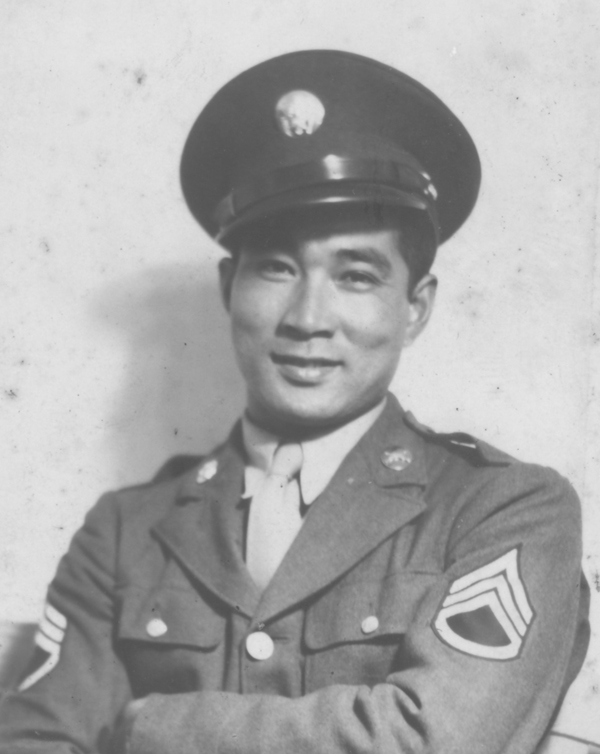
Takeichi Takejiro Miyashiro, known by his nickname “Chicken,” was born in Kohala, Hawaiʻi, in 1915, into a humble plantation family. His parents, Jensei and Ushi Miyashiro, had immigrated from Okinawa to work in the sugar camps, and Takeichi was one of six children. Although his birth certificate bore the name Takejiro, his parents planned to have him adopted into another family, which would have made him their “first son” — hence the name change to Takeichi. The adoption never came through, but the name stuck.
![Takeichi Miyashiro (Co. C, 100th Inf. Bn.) [Courtesy of Lorraine Miyashiro]](https://www.100thbattalion.org/wp-content/gallery/takeichi-miyashiro/Miyashiro-Takeichi-Takejiro.png "Takeichi Miyashiro (Co. C, 100th Inf. Bn.) [Courtesy of Lorraine Miyashiro]")
The story behind his nickname “Chicken” is rooted in island humor. There was another boy in school named Takeshi who went by the nickname, “Chicken,” and because Takeshi and Takeichi sounded similar to some, the moniker stuck to Miyashiro too — though it was entirely ironic, as he would come to be known for his bravery.
Growing up, Miyashiro was a standout athlete. As a child, Takeichi began school in Honomakaku; however, his family moved from one plantation to another before eventually settling in one of the camps of the Honokaʻa Plantation. He attended Honokaʻa School through the 10th grade. To complete his high school education, Miyashiro stayed at a boarding house in Hilo, where he finished the 12th grade at Hilo High School. There, he played football and basketball and ran track.
After graduation, during the tough years of the Great Depression, he worked part-time for Matson and Standard Oil Company in Hilo.
Miyashiro was part of the first draft and enlisted in the U.S. Army on December 8, 1940. He was sent to Schofield Barracks for training and was then assigned to Molokaʻi as part of the 299th Infantry. There, he served when the attack on Pearl Harbor happened and was promoted to sergeant. He formed a close bond with Lieutenant Spark Matsunaga, another Nisei who would later serve in the 100th Infantry Battalion, during his time on Molokaʻi.
Shortly after, in June 1942, Miyashiro became part of the newly formed 100th Infantry Battalion (Separate) — largely made up of Japanese American soldiers from Hawaii. He sailed to the mainland, trained at Camp McCoy and Shelby, and eventually was shipped out to fight in the European Theater.
His combat record was nothing short of extraordinary. As a platoon sergeant in Company C, he first saw action near Salerno, Italy in September 1943. Over the course of fighting, he was wounded multiple times but always returned.
In Italy, during a dawn assault near Castellina, Miyashiro demonstrated tactical brilliance and personal courage. He led a squad to neutralize a German machine-gun nest in a farmhouse that was hampering their company’s advance. Under intense fire, his men held their ground; he directed fire, repulsed counterattacks, and even after his automatic rifle jammed, he grabbed a carbine and continued fighting. His leadership and bravery in that action earned him the Distinguished Service Cross.
His wounds eventually forced him to withdraw; shrapnel struck him in the buttocks during a later operation, and he was hospitalized in Naples. But he returned to duty — eventually fighting in France with the 100th/442nd in October 1944, as they pushed through bitter forest fighting at Bruyères and Biffontaine.
In Biffontaine, in the dense woods and under heavy fire, he and his men captured about 28 German soldiers, including medics, in a daring assault. But the fighting was costly. Miyashiro was shot in the hip — the impact was so severe he was thrown back and lost his rifle. The very next day, while being evacuated, he and other wounded soldiers were captured by German forces.
![Fragments of American 0.30-06 Springfield cartridges removed from 2nd Lt. Takeichi Miyashiro’s wound, and German matchbox they were stored in. [Courtesy of Jan Sakoda]](https://www.100thbattalion.org/wp-content/gallery/takeichi-miyashiro/Miyashiro-Takeichi-Memorabilia.png "Fragments of American 0.30-06 Springfield cartridges removed from 2nd Lt. Takeichi Miyashiro’s wound, and German matchbox they were stored in. [Courtesy of Jan Sakoda]")
In his time as a prisoner of war (POW), he was moved through several hospitals — first under German care, then to a makeshift facility in Germany run by a British POW doctor, Dr. Frazier, who removed shrapnel and saved his life. Later, he was transferred to a POW camp in Poland, where he reunited with other Nisei officers.
In January 1945, as the Russians advanced, the camp was liberated, and he began an arduous journey home. At the Russian port of Odessa, he was placed on a ship bound for Port Said, Egypt. From there he went to Naples, Italy and then on to Miami, Chicago, several places in California, and finally to Seattle where a ship took soldiers back to Hawaiʻi.
After the war, Miyashiro was discharged in November 1945. He returned to civilian life, going back to work at Standard Oil, where he would retire as a plant foreman. In 1950, he married Lorraine Shiroma of Honolulu, and they raised three daughters: Nellis, Allyn, and Sonya.
Miyashiro was wounded several times during the war and received a battlefield commission, along with the Distinguished Service Cross and the Silver Star in recognition of his valor and sacrifice. Takeichi “Chicken” Miyashiro passed away in November 2003 at the age of 89.
His legacy endures among the American soldiers of Japanese ancestry of the 100th Infantry Battalion — not just for his battlefield heroism, but for his humanity: he was known for treating captured German medics with respect, and his men respected him deeply.
Coworkers and fellow veterans fondly remembered “Chicken” as a leader they could trust. Stanley Akita (Co. C), one of the men who served under him and a fellow POW survivor, said that Miyashiro had a way of positioning his men so well that you felt safe following him.
In the May 2003 issue of the Club 100 “Puka Puka Parade” newsletter, Joy Teraoka — editor and wife of veteran Denis Teraoka (Co. D) — wrote an article in his honor titled “Looking Back: Salute to Takeichi ‘Chicken’ Miyashiro.” She wrote:
“During the course of my interviews with other veterans, one name often came up as the men described their combat experiences. That was the name “Chicken” Miyashiro, uttered with admiration and respect for his dauntless courage and heroism.
Although the nickname “Chicken” gives the derogatory connotation of someone who runs away from conflict or lacks courage, by contradiction, the “Chicken” Takeichi Miyashiro of 100th Inf. Bn.’s C Company we are paying tribute to has the irrefutable reputation of a man of outstanding courage and valor.”
Fellow Company C veteran, Stanley Akita, recounted his memories of Miyashiro in his oral history (Hawaii Nisei Project 2006 – 2007):
“[Takeichi] ‘Chicken’ Miyashiro [was very influential to me]. He was the lieutenant. He was one of the amazing kind of guys … What he [Chicken Miyashiro] did was, he placed his men strategically … Guys like Chicken, you have a feeling you can follow him anywhere and you won’t get hurt.”
More documentation of Miyashiro’s combat experiences can be found in: “Ambassadors in Arms: The Story of Hawaii’s 100th Battalion” by Thomas Murphy, page 214 and “Remembrances: 100th Infantry Battalion 50th Anniversary Celebration, 1942 – 1992,” pages 176 and 177.
1st Lt. Takeichi “Chicken” Miyashiro’s life reflected courage, resilience, and a deep commitment to those he led and served.
![100th Bn. soldiers in formation at Camp McCoy, Wisconsin. [Courtesy of Lorraine Miyashiro]](https://www.100thbattalion.org/wp-content/gallery/takeichi-miyashiro/miyashiro_takeichi_002.jpg "100th Bn. soldiers in formation at Camp McCoy, Wisconsin. [Courtesy of Lorraine Miyashiro]")
![Takeichi “Chicken” Miyashiro dressed as a Wisconsin-Dells Indian, Wisconsin-Dells, Wisconsin. [Courtesy of Lorraine Miyashiro]](https://www.100thbattalion.org/wp-content/gallery/takeichi-miyashiro/miyashiro_takeichi_003.jpg "Takeichi “Chicken” Miyashiro dressed as a Wisconsin-Dells Indian, Wisconsin-Dells, Wisconsin. [Courtesy of Lorraine Miyashiro]")
![Soldiers gather around their bunks at Camp McCoy, Wisconsin to play instruments. [Courtesy of Lorraine Miyashiro]](https://www.100thbattalion.org/wp-content/gallery/takeichi-miyashiro/miyashiro_takeichi_004.jpg "Soldiers gather around their bunks at Camp McCoy, Wisconsin to play instruments. [Courtesy of Lorraine Miyashiro]")
![Takeichi Miyashiro at Camp Shelby, Mississippi. [Courtesy of Lorraine Miyashiro]](https://www.100thbattalion.org/wp-content/gallery/takeichi-miyashiro/miyashiro_takeichi_005.jpg "Takeichi Miyashiro at Camp Shelby, Mississippi. [Courtesy of Lorraine Miyashiro]")
![100th Battallion practices marching in formation at Camp McCoy, Wisconsin. [Courtesy of Lorraine Miyashiro]](https://www.100thbattalion.org/wp-content/gallery/takeichi-miyashiro/miyashiro_takeichi_007.jpg "100th Battallion practices marching in formation at Camp McCoy, Wisconsin. [Courtesy of Lorraine Miyashiro]")
![Takeichi Miyashiro poses in front of a corn field in Wisconsin. [Courtesy of Lorraine Miyashiro]](https://www.100thbattalion.org/wp-content/gallery/takeichi-miyashiro/miyashiro_takeichi_008.jpg "Takeichi Miyashiro poses in front of a corn field in Wisconsin. [Courtesy of Lorraine Miyashiro]")
![Takeichi Miyashiro in Italy. [Courtesy of Lorraine Miyashiro]](https://www.100thbattalion.org/wp-content/gallery/takeichi-miyashiro/miyashiro_takeichi_009.jpg "Takeichi Miyashiro in Italy. [Courtesy of Lorraine Miyashiro]")
![Takeichi Miyashiro and Isami Nihara get ready to be transported while in Europe. [Courtesy of Lorraine Miyashiro]](https://www.100thbattalion.org/wp-content/gallery/takeichi-miyashiro/miyashiro_takeichi_010.jpg "Takeichi Miyashiro and Isami Nihara get ready to be transported while in Europe. [Courtesy of Lorraine Miyashiro]")
![Takeichi Miyashiro at Camp McCoy, Wisconsin [Courtesy of Lorraine Miyashiro]](https://www.100thbattalion.org/wp-content/gallery/takeichi-miyashiro/miyashiro_takeichi_011.jpg "Takeichi Miyashiro at Camp McCoy, Wisconsin [Courtesy of Lorraine Miyashiro]")
![Formal Portrait of Takeichi Miyashiro [Courtesy of Lorraine Miyashiro]](https://www.100thbattalion.org/wp-content/gallery/takeichi-miyashiro/miyashiro_takeichi_012.jpg "Formal Portrait of Takeichi Miyashiro [Courtesy of Lorraine Miyashiro]")