
Headquarters Company, 100th Infantry Battalion
Edward Yoshio Ikuma was born in Honolulu, Hawaii, in 1919. When the second pre-war draft was instituted, he was inducted into the U.S. Army on March 25, 1941.
![Edward Ikuma (HQ Co., 100th Inf. Bn.) [Courtesy of Edward Ikuma]](https://www.100thbattalion.org/wp-content/gallery/photos-ikuma-edward/ikuma_edward_010.jpg "Edward Ikuma (HQ Co., 100th Inf. Bn.) [Courtesy of Edward Ikuma]")
At the time of the attack on Pearl Harbor on December 7, 1941, he was serving in Company A, 3rd Combat Engineers, 24th Infantry Division. That Sunday morning, he happened to be home in Honolulu on weekend leave. During the attack, an errant U.S. Army antiaircraft artillery shell landed on his cousin’s house in Honolulu and exploded, killing his cousin and her family. They were among the several civilian casualties of the attack that morning.
When news of the attack broke, he immediately reported to his temporary duty station at Kaneohe Naval Air Station. Later that day, he and other soldiers were trucked to Schofield Barracks.
That evening, his company commander, First Lieutenant Frasier, assembled the entire company. He recalled thinking that he and others might be disarmed and become prisoners of war. Instead, Lieutenant Frasier addressed the troops, telling them, “I want the Nisei soldiers to be treated as Americans, just like all of the rest of you,” or words to that effect.
He always remembered those orders his company commander gave that evening. He spent that night guarding the officers’ quarters at Schofield Barracks.
After the attack on Pearl Harbor, his grandfather, Kinai Ikuma, a Shinto priest in Honolulu, was detained and subsequently sent to an internment camp in New Mexico, where he remained for the duration of the war.
An original member of the 100th Infantry Battalion, Edward Ikuma served as the noncommissioned officer (NCO) in charge of the message center within the Communications Section of Headquarters Company. He participated in every battle action of the 100th. He recalled having the task of receiving the message relieving LTC Farrant Turner of command and delivering it to him.
When the war in Europe ended on May 8, 1945, the 100th was at an airfield in northern Italy. He and a few other 100th soldiers embarked on a unique path back to the U.S. They boarded a B-17 bomber and flew to North Africa, then to Dakar, Senegal in West Africa. From there they flew to Recife, Brazil and from there on a C-54 transport aircraft, flew on to Jacksonville, Florida. From Jacksonville, they took a train to Ft Sheridan, Illinois, near Chicago. They then took another train to San Francisco, where they boarded a ship to Honolulu.
The ship arrived after sunset, so it anchored offshore for the night. In the morning, it docked at a pier in Honolulu. There was no band, no hula girls, no cheering crowds. So he returned much like how he departed with the 100th on a ship on June 5, 1942 – quietly and with no fanfare. He simply took a taxi home. The war was finally over for him.
For his service, Sgt. Edward Y. Ikuma earned the Combat Infantry Badge, two Bronze Star Medals, and two Purple Heart Medals.
He was honorably discharged from the U.S. Army on October 1, 1945. The very next day, he began working as an electrician at Fort Shafter in Honolulu. He later became an electrical engineering technician for the U.S. Army Corps of Engineers, Far East Region, in Japan.
In January 1946, he married Hazel Maeda of Maunaloa, Molokai, Hawaii. Together, they raised four children.
Many years later, on July 2, 2014, in a ceremony aboard the French frigate FS Prairial, which was visiting Pearl Harbor, the French government awarded the Order of the Legion of Honor, France’s highest decoration, to Edward Ikuma for his wartime service in the liberation of France during World War II.
On August 21, 1943, the men of the 100th Infantry Battalion were deployed to Oran, Algeria, departing New York aboard the troopship S.S. James Parker. Exactly 79 years later, on August 21, 2022, Edward Ikuma passed away peacefully at the age of 103 (or 105, as his birth was not officially registered until he was two years old). He was the last surviving member of the original soldiers of the 100th Infantry Battalion.
![Ed Ikuma (far right) with friends on furlough in Italy [Courtesy of Edward Ikuma]](https://www.100thbattalion.org/wp-content/gallery/photos-ikuma-edward/ikuma_edward_008.jpg "Ed Ikuma (far right) with friends on furlough in Italy [Courtesy of Edward Ikuma]")
![Ed Ikuma (far left) with friends in Italy [Courtesy of Edward Ikuma]](https://www.100thbattalion.org/wp-content/gallery/photos-ikuma-edward/ikuma_edward_003.jpg "Ed Ikuma (far left) with friends in Italy [Courtesy of Edward Ikuma]")
![Ed Ikuma in Menton, France [Courtesy of Edward Ikuma]](https://www.100thbattalion.org/wp-content/gallery/photos-ikuma-edward/ikuma_edward_013.jpg "Ed Ikuma in Menton, France [Courtesy of Edward Ikuma]")
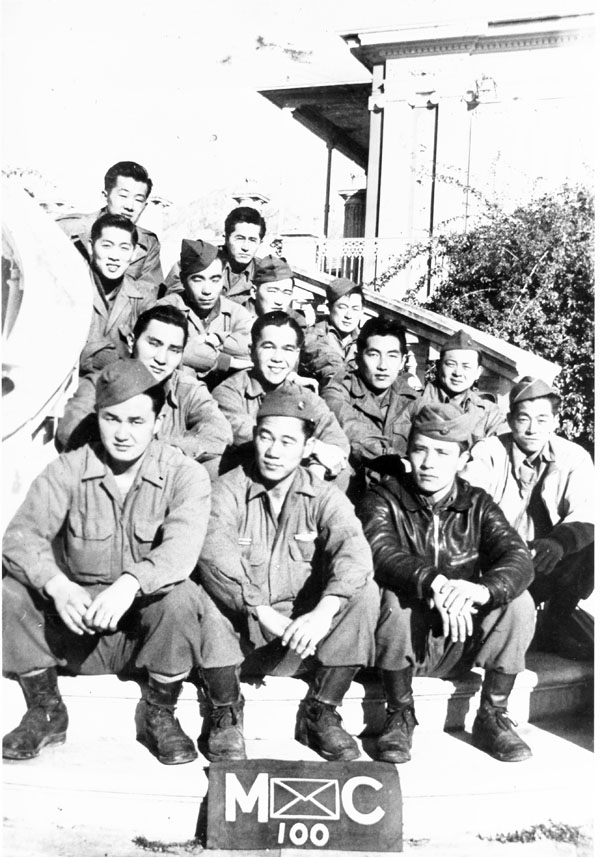
![Soldiers gather on the hillside at Cassino, Italy [Courtesy of Edward Ikuma]](https://www.100thbattalion.org/wp-content/gallery/photos-ikuma-edward/ikuma_edward_004.jpg "Soldiers gather on the hillside at Cassino, Italy [Courtesy of Edward Ikuma]")
![Shigeru Ushijima from Hilo and Ed Ikuma eat lunch during a break at the firing range at Camp McCoy, Wisconsin, August 1942 [Courtesy of Edward Ikuma]](https://www.100thbattalion.org/wp-content/gallery/photos-ikuma-edward/ikuma_edward_005.jpg "Shigeru Ushijima from Hilo and Ed Ikuma eat lunch during a break at the firing range at Camp McCoy, Wisconsin, August 1942 [Courtesy of Edward Ikuma]")
![Roy Honbo and Edward Ide play with icicles at Camp McCoy, Wisconsin, winter 1943 [Courtesy of Edward Ikuma]](https://www.100thbattalion.org/wp-content/gallery/photos-ikuma-edward/ikuma_edward_012.jpg "Roy Honbo and Edward Ide play with icicles at Camp McCoy, Wisconsin, winter 1943 [Courtesy of Edward Ikuma]")