
Able Company, 100th Infantry Battalion
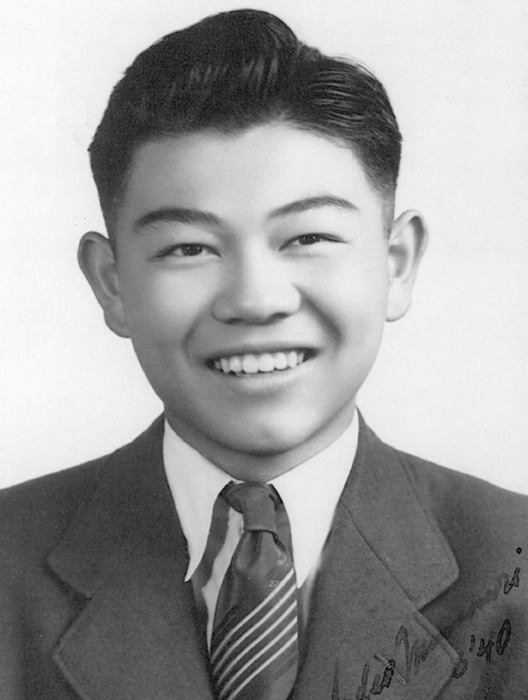
He was a lively youngster, and his sister Yaeko, just above him in age and herself something of a tomboy, later recalled one of their usual childhood fights when Sadao was about eight years old. When he realized he was losing the fight, he pouted and said, “You just wait. When I grow up, they’re going to name a ship after me. And I’m not going to let you ride on it!”
As a young man, Sadao enjoyed working on automobiles and pursued automotive training both at Lincoln High School and at the former Frank Wiggins School. He hoped to become an auto mechanic. Family and friends knew him by the nickname “Spud,” earned in childhood because he preferred potatoes to rice.
When World War II reached the United States, Sadao set aside his personal ambitions to serve his country. Following the death of his father, his older brother Isao had assumed responsibility as head of the family. Sadao volunteered for the U.S. Army so that his older brother would not have to go into the service. In fNovember 1941, one month before the attack on Pearl Harbor, Sadao signed up for the U.S. Army. He was formally inducted into military service at Eagle Rock, California, on February 11, 1942.
While Sadao was serving in the U.S. Army, his family, along with thousands of other Japanese Americans, was forcibly removed from their home and incarcerated at the Manzanar War Relocation Center.
Initially selected for training at the Military Intelligence Service Language School (MISLS), Sadao instead chose to transfer to the 442nd Regimental Combat Team (RCT), then training at Camp Shelby. According to family accounts, his oldest sister Yuriko’s husband had been drafted into the Imperial Japanese Army, and Munemori preferred not to serve in a role that might place him in direct opposition to his brother-in-law. To join the 442nd RCT — a segregated unit composed of Americans of Japanese ancestry (AJA), he accepted a reduction in rank from Technical Sergeant to Private and underwent basic training with the unit.
Sadao was transferred from the 442nd RCT as an early replacement to the 100th Infantry Battalion, the first unit composed primarily of AJA soldiers. On May 8, 1944, Private First Class Munemori joined Company A of the 100th Infantry Battalion in Anzio, Italy.
He fought in some of the most challenging campaigns of the European Theater, including the Battle of Bruyères, the rescue of the “Lost Battalion” in France’s Vosges Mountains, the Champagne Campaign, and the final Allied offensive in Italy’s Po Valley.
Sadao’s letters home revealed his deep affection for his fellow soldiers from Hawaiʻi. From Camp Shelby, he wrote, “These Hawaiian buddies of mine sure treat me nice.” From the New York Port of Embarkation, he wrote, “One thing about these guys I’m with is that they are always happy and cheerful. I’m just gonna have to visit my buddies in Hawaiʻi after the war.” From Anzio, he wrote, “The 100th Inf. boys are really a swell bunch of guys and they give us good advice which soaks in our brains faster than anything in the world.”
From France, he wrote, “All of us boys are already thinking of the future and the fellows want me to come to Hawaiʻi and visit them for sure. That’s one thing that I’ll have to do when I return. You know how I couldn’t get along too good with Japanese boys back home. Well I can get along pretty good with these guys because they don’t try to hold back anything. Yes, Keech! I’m gonna have to visit them after the war.”
From a hospital bed in France in January 1945, while recovering from yellow jaundice, he wrote to Yaeko that he would be back with the boys soon, “if there are still some guys I know left. The 100th isn’t the same outfit it used to be when I joined it at Anzio because it’s made up mostly of replacements, but it’s still a very powerful unit.”
Fellow 100th Co. A soldier Stanley Izumigawa later recalled that “Spud” quickly became a valued member of the unit. Although most soldiers in the 100th Infantry Battalion were from Hawai‘i, Munemori easily fit in. Izumigawa remembered him as “very friendly, outgoing, accepting,” adding that “it didn’t take him long to pick up pidgin and become one of us.”
Izumigawa also remembered a moment during the fighting in the Vosges Forest. After weeks of intense combat and heavy casualties, Munemori confided that he did not want to return to the front lines. Yet when the battalion moved out before dawn the next morning, he was there with his fellow soldiers, demonstrating the quiet endurance, perseverance, and courage that characterized so many members of the unit.
Another cherished memory occurred in Italy near Carrara in the spring of 1945. Discovering several cartons of Christmas candy at company headquarters, Munemori and Izumigawa filled musette bags and distributed the treats to local children in the town. Within minutes, children seemed to come from everywhere, surrounding the two soldiers and creating what Izumigawa later jokingly described as a “small riot.” Overwhelmed by the growing crowd of children, the two soldiers dumped the remaining candy on the street and ran. It was one of Izumigawa’s last memories of his friend before Munemori was killed in action a short time later.
On April 5, 1945, during the Allied assault on the German Gothic Line near Seravezza, Italy, Company A of the 100th Infantry Battalion scaled steep cliffs under cover of darkness to launch a surprise attack at dawn. When his squad leader was wounded, Munemori assumed command and single-handedly destroyed two enemy machine-gun positions with grenades. Moments later, when an enemy grenade bounced off his helmet and landed near two fellow soldiers, he threw himself onto the grenade, smothering the blast with his body and saving their lives at the cost of his own.
For his extraordinary heroism, Munemori was posthumously awarded the Distinguished Service Cross, which was later upgraded to the Medal of Honor on March 13, 1946. He became the first Japanese American Medal of Honor recipient of World War II, the nation’s highest military decoration for valor. The award was presented to his mother, Nawa Munemori. He also received the Purple Heart and the Combat Infantryman Badge.
In 1980, fourteen years after the passing of Sadao’s mother, the remaining members of the family decided to present Sadao’s Medal of Honor to the Hawaiʻi Army Museum at Fort DeRussy. On Maui the following day, Andy Shishido read about the presentation in the newspaper. He flew to Honolulu and sought out the two sisters who had made the donation to the museum. Shishido and the sisters were complete strangers to one another.
With a repentant heart, Shishido asked for forgiveness — for if it had not been for Sadao, he would not be alive today. Shishido was one of the two men who had been in the shell crater when the grenade came bouncing toward them.
But the two sisters told him there was nothing to forgive. They were grateful that Sadao’s action had made it possible for him to live.
Upon hearing their words, Shishido said, “You just don’t know what your words mean to me. For 35 years, I have been carrying a cross-filled with guilt and remorse – knowing that the only reason I live is because of the death of Sadao. You have just lifted that heavy cross off my back.” And then he returned to Maui.
In 1947, the troopship SS Wilson Victory was renamed the USAT Private Sadao S. Munemori in his honor. It was the first U.S. Army troopship to be named in honor of a Japanese American soldier. When the ship made its first call to Honolulu shortly after its redesignation, Yaeko was invited to be the first to board it. Memories crowded upon her as she awaited the day. As she prepared to board the ship, the moment carried emotional weight as Sadao’s childhood words seemed to echo across time: “And I’m not going to let you ride on it…”
Yaeko’s ties to the 100th Infantry Battalion, which began with her brother Sadao, were further deepened by her marriage to Albert Yokoyama, an original member of the 100th Infantry Battalion (Separate) Medics.
Munemori’s legacy has also been honored in Italy. In Pietrasanta, Italy, a bronze statue of Sadao Munemori was dedicated in 2000. Munemori was selected as a symbol of all of the fallen of the Allied Forces because of his outstanding heroism over and beyond the call of duty.
In 2023, the City of Glendale dedicated Sadao S. Munemori Memorial Square at the intersection of Broadway and North Isabel Street near Glendale City Hall in Los Angeles County, honoring his sacrifice and legacy as the city’s Medal of Honor recipient.
Sadao Munemori’s sacrifice is not forgotten, and his story continues to be remembered and to inspire future generations.
—
Read more about Sadao S. Munemori: