
Baker Company, 100th Infantry Battalion, 442nd RCT
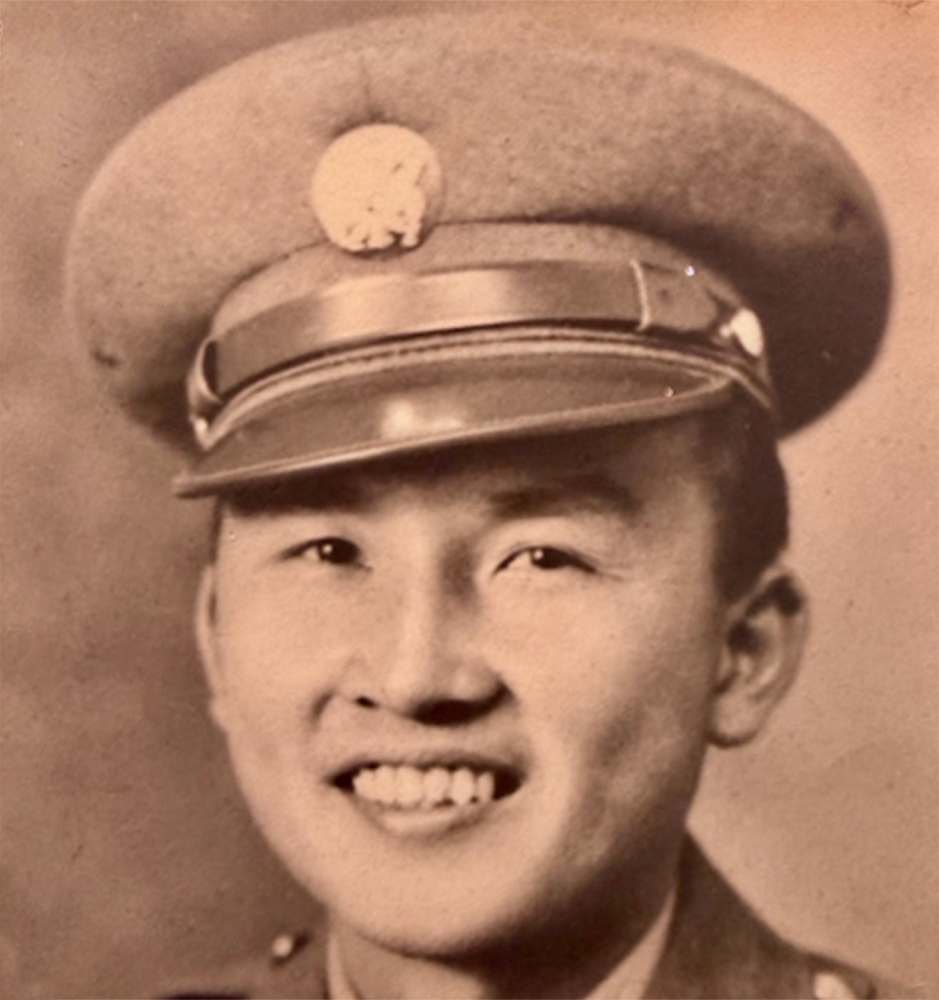
James Futoshi Tani was born on May 11, 1919, in Kahului, Maui, Territory of Hawaii. The fourth of seven children, James was the only son of Mitsuzo and Sumi (Matsumoto) Tani. In 1898, Mitsuzo boarded a steamship for Hawaii, eager to make his fortune on the sugar plantations. A native of Shiota, Yamaguchi prefecture, he eventually settled in the Islands and brought over Sumi Matsumoto, a young picture bride from the neighboring village of Yanai. Together, they ran a successful blacksmith shop in the bustling port town of Kahului.
James grew up a scrappy, outgoing kid. He and his buddies played and swam in the fast-flowing irrigation ditches of the sugar cane fields, where he’d best them in the crawl. Coach Soichi Sakamoto spotted James’ talent and invited him to join Maui’s legendary Three-Year Swim Club, but the young boy brushed him off, saying he’d rather play basketball. As the only son, James was pampered, not only by his parents but by older sisters Doris Masayo, Fusae and Molly Kaoru. Younger sisters Elizabeth Misaki, Yachiyo and Sally Shinobu admired and looked up to their elder brother.
On July 18, 1926, a horrific car accident killed Mitsuzo and daughters Fusae and Yachiyo on their way back from a family outing. In the turbulent aftermath of the accident, mother Sumi went to work as a seamstress and eventually earned enough to move the family of six into a one-bedroom house behind Iao Theater in the heart of Wailuku. James would hop on the 6 a.m. steam-engine train to Hamakuapoko, then walk to Maui High School, where he was a member of the Representative Assembly and played on the football and varsity basketball teams. He also represented Maui in a statewide oratory contest in Honolulu, which inspired him to attend the University of Hawaii.
Pearl Harbor
On June 30, 1941, James was drafted into the Hawaii National Guard, a federalized force mobilized to protect Oahu from potential attack. He was a 21-year-old freshman and varsity swimmer at the University of Hawaii. In the early morning of December 7, 1941, James was at home, preparing to return to Schofield Barracks, where he’d been training for the past six months. He sat eating breakfast while his mother made makizushi for him to take back for his fellow soldiers. Suddenly, frantic alerts cut into the radio broadcast: Pearl Harbor was under enemy attack; soldiers were to report immediately to their bases. James sprinted out the door, leaving Sumi in tears. She didn’t know if she’d ever see her only son again.
Mainland Training
On June 5, 1942, James was among 1,432 soldiers that departed from Honolulu on the U.S.A.T. Maui, headed for “destination unknown.” Seasickness plagued the men, especially the ones who, like James, had never left the Islands. The hardier ones could try their luck in a rowdy game of craps that ran day and night down in the hold. A week later, disembarking in Oakland, the soldiers learned they’d been designated the 100th Infantry Battalion (Separate), or “One Puka Puka.” James Tani, serial number 30101516, was a Sergeant and later, Staff Sergeant, of Company B, 1st Platoon. At 5’4” and 125 pounds, he embodied the average height and build of Nisei recruits, who were notably smaller than their husky mainland counterparts.
The troops trained hard for six months at Camp McCoy, Wisconsin, practicing close-order drills and digging foxholes, scrambling over obstacle courses, and assembling and disassembling their weapons. The Nisei were driven by the desire to outperform other troops, to prove their loyalty and, above all, to be recognized as Americans. James, called “Jimmy” or “Foot,” was skilled at poker, which the men would play during off-duty hours. His closest friend was Takashi Kitaoka, from Hana, Maui. At Camp McCoy, the men also began laying out plans to build a clubhouse after the war, contributing $2 each from their monthly paychecks for what would become the Club 100 in Honolulu.
In early January 1943, the 100th relocated to Camp Shelby, Mississippi, for advanced combat training. In contrast to the hospitality of Wisconsin, where the men were welcomed by the surrounding community, in Mississippi, the men witnessed the profound inequalities of Jim Crow segregation. The soldiers were advised to stay in the white sections of nearby Hattiesburg, after the town declared them “honorary haoles,” but the distinction didn’t always help. Bob Sakoki of Company B recalled a time when the guys were catching a bus into Hattiesburg, and one soldier, who was dark-skinned, sat in front with his pals. The bus driver ordered him to the back of the bus, but his friends leapt up, yelling, “He’s from Hawaii!” The driver drove on in silence. By the end of summer, the 100th was ready to leave Mississippi. They boarded the S.S. James Parker, from Staten Island, and joined a convoy headed across the Atlantic. While none of them knew their precise destination, they knew they were headed for combat.
“Go for Broke”
After landing in Oran, Algeria, on September 2, the 100th was initially assigned to guard supply trains but their commander, Lt. Colonel Farrant L. Turner, insisted on a combat mission. “The Old Man would not accept the assignment,” recalled Fundee Shirai. “He argued that the 100th didn’t come all the way from Hawaii just to do guard duty. ʻWe want to take our part in combat to prove our loyalty to our country,’ [Turner] maintained.” As a result, the 100th was assigned to the 34th Infantry “Red Bull” Division as its unofficial 2nd Battalion.
After the Battalion’s 1,300 men landed in Salerno, Italy, they went on to fight in the succeeding Naples-Foggia and Rome-Arno Campaigns, driving the Germans into retreat. While intensive training had transformed them into a cohesive, disciplined unit, nothing could have prepared them for the brutal realities of war. James was pinned down for three days in a foxhole; he humped his 60-pound pack and weapons over heavily mined terrain, and, in a searing moment, saw his buddy shot and killed just steps in front of him. The 100th was nicknamed “The Purple Heart Battalion,” due to its staggering casualty rate. The 100th and the 442nd Regimental Combat Team (to which it later was assigned) became the most heavily decorated unit in U.S. history for its size and duration of service.
Courage under fire
In late November, the 100th was assigned the formidable task of taking a series of peaks to reach La Croce, a mountain south of the town of Scapoli. La Croce was the strategic linchpin in Germany’s Winter Line defense, which allowed the Nazis to control transport across the Volturno River and into Monte Cassino. The heavily fortified peaks posed a challenge to the Nisei, who battled ice and freezing rain in scaling mined slopes that had been pre-sighted as Nazi “kill zones.” On their way up one ridge, Company B repelled a fierce flank attack and took out several machine guns. James was awarded his first Bronze Star in this costly battle, demonstrating “heroic achievement in combat.”
After New Year’s Eve, the 100th and the 34th Division were ordered to attack S.S. troops entrenched along the hillsides of Cassino, a pivotal chokepoint that became a major turning point of the war. The only approach was across a perilous no-man’s land that had been stripped of scrub to give German machine-gunners a clear line of sight. Troops had to traverse a deadly stretch of land composed of flooded farm fields and roads, deep irrigation ditches and mine-strewn cornfields in order to reach the banks of the Rapido River.
On January 24, Companies A and C led the attack and reached the river wall, where they organized a crossing over the dry riverbed. Company B started to join them but was repelled by an unrelenting barrage of artillery and machine-gun fire. Their commanding officer was wounded and his replacement killed, forcing the Battalion into retreat.
Once again, James displayed exemplary courage. “On January 24, 1944, in the vicinity of Cassino, Italy,” his second Bronze Star Medal citation stated, “when his platoon leader became a casualty, he reorganized his platoon and personally led them across 300 yards of open terrain, undergoing intense artillery fire. Under his leadership, a defensive position was established, thus securing a line of departure and making it possible for his battalion to attack west toward the Rapido River.”
As James was helping two wounded officers to safety, he was hit in the foot by machine-gun fire. Cassino was taken some months later in partnership with multi-national troops. Of the original 1,300 men from the 100th that had landed eight months earlier in Salerno, just 521 remained standing. The Battalion’s outstanding courage and sacrifice helped ensure the Allies’ ultimate triumph.
Returning Home
After recuperating at Stark and Torney General Hospitals in North Carolina and California, respectively, James returned to Honolulu, where his mother and sisters greeted him with armfuls of plumeria and carnation lei. He was assigned to limited duty as a foreman with the 1399th Engineer Construction Battalion, aka “the Chowhounds,” was discharged on June 24, 1945, and returned to the University.
Students joyfully celebrated the war’s end and flocked to jukebox mixers, May Day pageants and campus beauty contests. The history/economics major slipped easily into the swing of things. Four years of his life had been dedicated to the nightmare of war, now, he was eager to embrace the routines of college life. He served as a two-time member of the student council, a sports manager and on the selection committee for beauty contestants. He also was elected vice president of Gamma Iota Alpha (GIA), a newly formed veterans’ fraternity on campus.
During one GIA meeting, James raised the vexing issue of campus dating, asserting that college girls had been spoiled by dating Mainland fellows during the war. “These days a man has to be a combination of Orson Welles and Van Johnson to date a girl,” he declared. “A five-foot girl won’t go out with a five-foot, five-inch Islander anymore – she has to have a six-foot Mainlander.” A co-ed countered that the veterans had been similarly swayed by Italian and French women, but Chaplain Masao Yamada of the 442nd came to the men’s defense. “Those European girls have a fine, wholesome attitude. But an Island girl – good grief, if you take her out twice you practically have to marry her!”
In fact, James had his eye on one co-ed. Carolyn Sau Kai Loo was a spirited, Chinese-Hawaiian education major from Honouliuli, Ewa, whom he’d met in the campus bookstore. He proposed on their first date, she said yes, and the couple soon married at the Church of the Crossroads. James opened his own insurance firm in Honolulu, and settled into married life. He was elected president of the PTA at his children’s school, but his community involvement centered on Club 100. He played on its golf team, sponsored baseball games and volunteered for events and on political campaigns. He loved to host boisterous poker games at his home in Kahala, where the guys would crowd around two large, felt-topped tables.
James and Carolyn raised five children: Jalyn, Carlyn, Jason, Carson and Jonn. The proud father celebrated his children’s high school graduations and college departures. While James rarely spoke to his children about the war, his medals testify to his exemplary service. He received the American Defense Service Medal with Metal Clasp; Asiatic Pacific Service Medal; Good Conduct Medal; Purple Heart Medal; National Defense Service Medal; and Bronze Star with Oak Leaf Cluster. James F. Tani was among the veterans of the 100th Infantry Battalion, 442nd Regimental Combat Team, and Military Intelligence Service honored with the Congressional Gold Medal, authorized on October 5, 2010, in recognition of their service during World War II. Conferred by the U.S. Congress, the award states: “The United States remains forever indebted to the bravery, valor, and dedication to country these men faced while fighting a two-fronted battle of discrimination at home and fascism abroad. Their commitment and sacrifice demonstrate a highly uncommon and commendable sense of patriotism and honor.”
On March 1, 1977, James passed away suddenly and unexpectedly at age 57. He would never get to see his children forge accomplished lives of their own. Still, in professions ranging from law and medicine to journalism and fire fighting, each found a way to exemplify their father’s values of service and commitment.
James and Carolyn are buried together at Punchbowl (Section 1, site 797) amidst sweeping lawns and expansive monkeypod trees. Early in their marriage, James chaired a Club 100 memorial service at the cemetery for their fallen comrades. The date of the service, September 29, 1951, honored the day eight years earlier when the Battalion first faced the enemy in active combat near Salerno, Italy, and suffered its first soldier killed in action. The hundreds of veterans in attendance were surrounded by the silent graves of their brothers, cousins and friends who’d fought so fiercely alongside them in battle. Former Lt. Col. Farrant L. Turner, “the Old Man,” reminded the men to always “preserve that for which you fought in the mud, snow and hills of Italy and France.” Even in peacetime, he cautioned, America’s ideals can come under threat. He urged them to forever uphold “the ideals for which the fighting was done.”
As James listened to Col. Turner, he may have reflected on the unlikely trajectory of his own life. He survived a car crash that killed his father and sisters and came back from a world war that took the lives of so many brothers-in-arms. For this Maui-born son of a blacksmith, the chance to stand at Punchbowl with this extraordinary band of brothers was the greatest achievement of his life. Together, they turned the tide of history and proved themselves true American heroes.
—–
This biography was prepared by James F. Tani’s daughter, Carlyn Leinani Tani, in November 2026 for the 100th Infantry Battalion Veterans (Club 100) Education Center.